Light-Driven Superconductivity Control via Integrated Cavity
A New Way to Control Superconductivity
For the first time, scientists have shown that a material's superconductivity can be changed by connecting it to an internal light-trapping cavity. In experiments published in Nature, a group led by Itai Keren at Columbia University demonstrated how quantum properties can be intentionally shaped by combining specific materials—without using any external light, pressure, or magnetic field.
Understanding Emergent Properties
As researchers have examined the quantum behavior of solids more closely, they've discovered many "emergent" properties. These arise from complex interactions between electrons, quantum spins, and vibrations in a crystal lattice. Examples include superconductivity, magnetism, and charge ordering. These phenomena are more intricate and complex than the individual parts that make them up.
Building on this, physicists are now looking into whether materials can be designed with specific emergent behaviors already built into their structures. The aim is to engineer the quantum environment from the start, rather than changing a compound after it has been made.
Creating a Resonant Electromagnetic Environment
In their study, Keren and his team explored if a material’s quantum properties could be changed by having its own photonic cavity. In traditional systems, cavities are made from two mirrors that reflect light back and forth. By adjusting the distance between the mirrors, researchers can trap light at certain frequencies, creating a resonant electromagnetic mode.
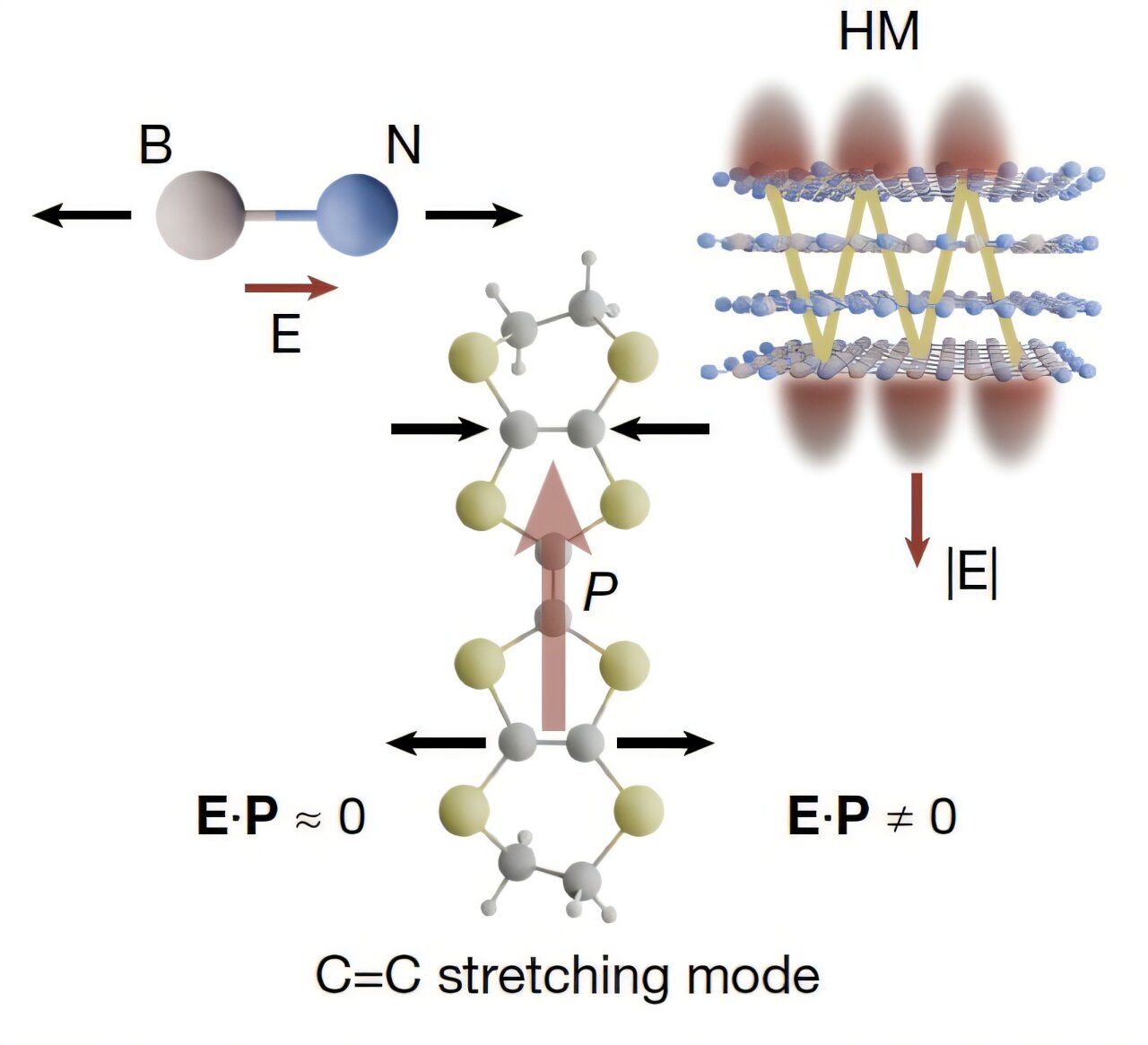
To create an internal version of such a cavity, the team used a thin crystal of hexagonal boron nitride (hBN). This material consists of atom-thick layers held together by weak van der Waals forces. Within certain infrared frequency ranges, light traveling parallel to the layers strongly couples to atomic lattice vibrations. This creates a hybrid light–matter excitation that becomes tightly confined inside the slab, effectively making the hBN act as an internal infrared cavity.
Changing Superconductivity
The researchers then placed this hBN sheet onto a molecular superconductor—a compound made of large, carbon-based molecules arranged in conducting layers. Within each molecule, carbon–carbon double bonds naturally vibrate at infrared frequencies, and these vibrations are known to play a role in the emergence of superconductivity.
When the two materials were brought together, the infrared modes of the superconductor resonantly coupled with the confined modes of the hBN cavity. This changed the local electromagnetic environment at their interface. As a result, the superconductor's superfluid density was significantly reduced—even in total darkness, without any external laser illumination.
Engineering Quantum Materials
This approach is different from most quantum materials studied so far, which usually require changes in chemical composition or external adjustments like temperature, pressure, or magnetic fields.
By showing that superconductivity can be modified simply by attaching a material to another structure with an internal electromagnetic cavity, Keren's team provides strong evidence that quantum ground states can be engineered through their surrounding vacuum environment.
These findings could lead to new ways of creating advanced materials where quantum properties are fine-tuned during the design phase, without needing to constantly adjust external conditions.
