Astronomers Decipher 'Inside Out' Planet System
A Unique Planetary System Challenges Existing Theories
Astronomers have discovered a planetary system that defies current understanding of how planets form. This system features a rocky planet located beyond the orbits of its gaseous neighbors, suggesting it formed after most of the available planet-forming material had already been used up.
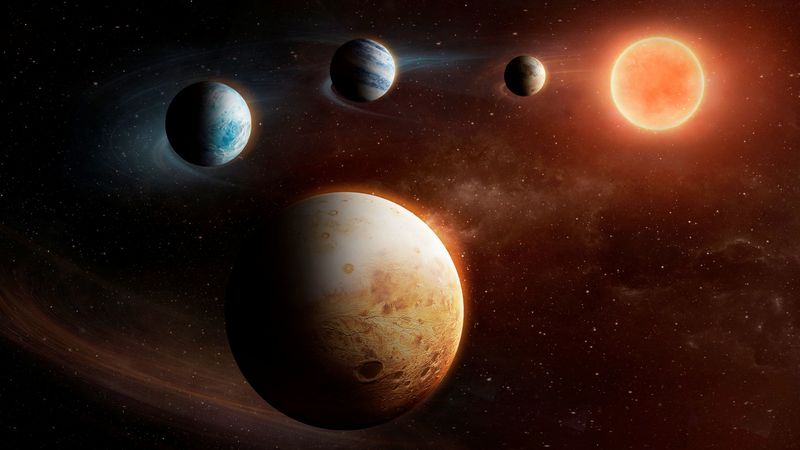
The system was observed using the European Space Agency's Cheops space telescope. It consists of four planets—two rocky and two gaseous—that orbit a small and dim star known as a red dwarf. This star, named LHS 1903, is approximately 117 light-years away from Earth in the direction of the Lynx constellation. A light-year is the distance light travels in a year, which equals about 5.9 trillion miles (9.5 trillion kilometers).
LHS 1903 is roughly half as massive as our sun and only 5% as luminous. What makes this system particularly intriguing is the order of the planets. The innermost planet is rocky, followed by two gaseous planets, and then the fourth planet, which should theoretically be gaseous according to current planetary formation theories, turns out to be rocky instead.
"This system challenges the planet-formation paradigm," said Thomas Wilson, an astronomer from the University of Warwick in England and lead author of the study published in the journal Science. "The prevailing theory suggests that planets close to their host star should be small and rocky, with little-to-no gas or ice, due to the high temperatures in that region. Conversely, planets at larger distances are expected to be gas-rich. This system gives us a rocky planet outside of gas-rich planets, which is quite unusual."
Wilson described the system as "a system built inside-out." In our solar system, the four inner planets are rocky, while the outer planets are gaseous. Beyond the gas planets, there are smaller rocky dwarf planets like Pluto, but none as large as the planets in our solar system.
To date, astronomers have detected around 6,100 exoplanets since the 1990s. All four planets in this newly observed system orbit closer to their star than Mercury does in our solar system. In fact, the outermost planet orbits at just 40% of the distance between Mercury and the sun. This is typical for planets orbiting red dwarf stars, which are much less powerful than our sun.
The two rocky planets in the system are classified as super-Earths, meaning they are rocky like Earth but two to 10 times more massive. The two gaseous planets are mini-Neptunes, which are gaseous and smaller than Neptune but larger than Earth.
Researchers believe that these planets did not all form at once in a large disk of gas and dust surrounding their star. Instead, they may have formed sequentially, with the gas that would have contributed to the atmosphere of the fourth planet being used up by the other planets before it could fully form.
Wilson referred to the fourth planet as a "late bloomer." "It formed later than the other planets in a gas-poor environment. There wasn't so much material to build this planet," he explained.
Another possibility is that the fourth planet originally had a large gas atmosphere that was later stripped away, leaving behind just a rocky core. "Did it arrive just as the gas ran out? Or did it suffer a collision with another body that removed its atmosphere?" asked Andrew Cameron, a co-author of the study from the University of St Andrews in Scotland. "The latter sounds fanciful until you remember that the Earth-moon system appears to be the result of such a collision."
This fourth planet also raises interesting questions about potential habitability. With a mass 5.8 times that of Earth, it has a surface temperature of about 140 degrees Fahrenheit (60 degrees Celsius). "A temperature of 60 degrees Celsius is very similar to the hottest temperature recorded on Earth, 57 degrees Celsius, so it's definitely possible that this planet is habitable," Wilson said. Future observations using the James Webb Space Telescope could provide more insights into the conditions on this planet and help determine its potential for habitability.
