Can the KF-21 Rival Global Aviation Giants?
South Korea's KF-21: A New Era in Indigenous Fighter Jet Development
South Korea has taken a significant step forward in its pursuit of self-reliance in advanced military technology with the recent roll-out of the KF-21 Boramae, marking its entry into an elite group of nations capable of developing supersonic combat aircraft independently. This achievement places South Korea among only eight countries that have successfully created such advanced systems, including the United States, China, Russia, France, Sweden, India, and Japan.
The KF-21 is the first domestically developed fighter jet by South Korea, representing a major milestone in the country’s aerospace industry. The initial production model, known as Block I, was unveiled in March 2023 by Korea Aerospace Industries (KAI), signaling the start of mass production for this 4.5-generation fighter. The South Korean Air Force plans to receive 40 Block I units by 2028, focusing primarily on air superiority missions.
Despite this progress, analysts suggest that the KF-21 still has a long way to go before it can compete effectively on the global stage. Bence Nemeth, a senior lecturer in defense studies at King’s College London, noted that while the KF-21 could be competitive in overseas exports, it entered a "late and crowded market." He highlighted that South Korea's advantages may lie in cost, quality, delivery speed, and willingness to offer industrial cooperation. However, he also emphasized that the procurement of fighter jets is often influenced by political alignment and wartime supply chain reliability.
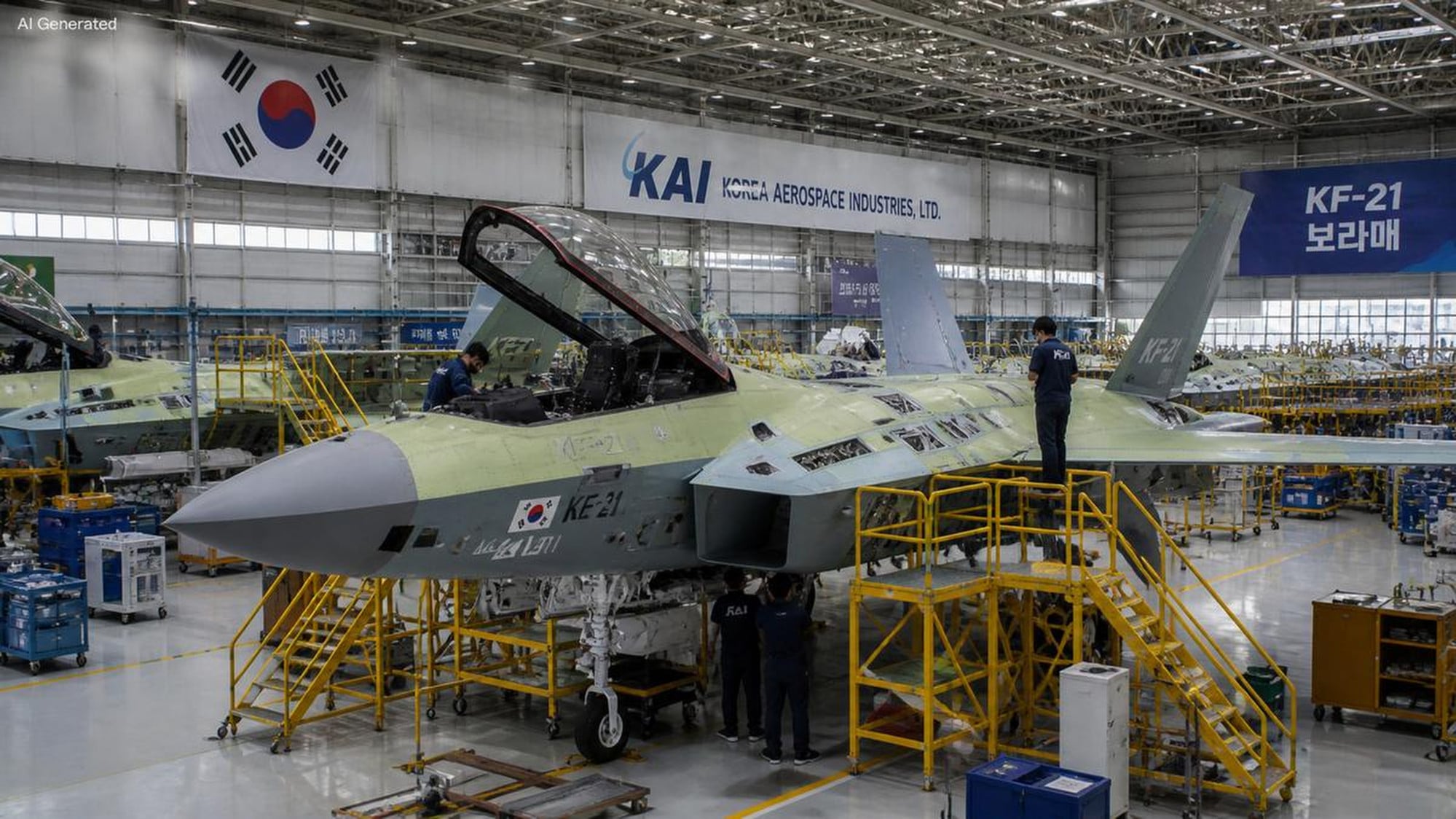
Nemeth argued that the KF-21 would need aggressive marketing and credible long-term sustainment guarantees to gain traction. He suggested that a stealthier version of the KF-21 could potentially compete more directly with fifth-generation aircraft, but this depends on future upgrades, marketing efforts, and political ties between Seoul and potential markets.
South Korea is actively working to boost exports of the KF-21 to reduce per-unit costs and compete with other 4.5-generation fighters from China, the US, and Europe. Indonesia, which co-produces the KF-21, is reportedly considering purchasing 16 Block II aircraft. However, the project has faced controversy due to Jakarta's request for a reduction in its financial contribution. In response, Seoul agreed to a revised cost-sharing agreement, significantly lowering Indonesia's share and shifting more financial responsibility to South Korea.
Yang Uk, a research fellow at The Asan Institute for Policy Studies, pointed out that many countries might be interested in operating the KF-21 due to its cost-effectiveness. However, he noted that the lack of a combat record remains a limitation. According to Yang, discussions about the KF-21 can only begin once Block II is completed, as the performance of the initial Block I model is not yet fully realized.
Kim Ki-won, a professor at Daekyung University, emphasized the importance of strengthening South Korea's own air force capabilities to respond to multiple aerial threats. He highlighted the need for autonomous technology in manned-unmanned teaming (MUM-T) systems, where human-operated platforms like fighter jets work alongside autonomous drones.
Kim pointed out that aerial threats, such as North Korean missiles and drones, and Chinese fighter jets and drones, are becoming increasingly severe. He believes that if empirical results for MUM-T systems are achieved, a niche market will open up for countries facing air defense challenges from powerful air forces.
Choi Gi-il, a professor at Sangji University, described the KF-21's development as not yet complete. He noted that the KF-21 still has a "long way to go" to match its 4.5-generation counterparts like the Chinese J-10C and the French Rafale. Although research on MUM-T has already begun, Choi believes that transitioning to a sixth-generation fighter will take considerable time.
First announced in 2001 and formally launched as a development project in 2015, the KF-21 represents a quarter-century effort by South Korea to field an indigenous fighter jet. It is scheduled to replace the Republic of Korea Air Force's aging F-4 and F-5 fleets.
Block I aircraft focus on air superiority missions, equipped with beyond-visual-range Meteor and short-range IRIS-T air-to-air missiles. Meanwhile, Block II upgrades are expected to feature full air-to-ground and air-to-ship mission capabilities, with completion scheduled for early next year. Block III is likely to enter the fifth-generation model with full stealth capabilities by adding internal weapons bays and could include sixth-generation features such as MUM-T, with drone wingmen flying alongside. Completion is scheduled for the 2030s.
Kim believes that the KF-21 could achieve overwhelming air superiority and secure a sufficient amount of "kill chain" forces to provide a credible deterrent against North Korean threats. He also noted that the KF-21 could ensure a steady supply of weaponry and reduce reliance on foreign military support, granting Seoul more flexible operational execution.
He added that South Korea has sufficient technological capabilities to autonomously upgrade the KF-21 to a fifth-generation fighter jet.
