Heart-shaped cloud erupts in time for Valentine's Day
Who said science wasn’t romantic? Just in time for Valentine’s Day, a heart-shaped cloud of dust and gas has been discovered billowing out of a star just 300 light-years from Earth.
Astronomers studying the elderly red giant star Mira A say that both the volume of material and the speed at which such was released were unexpected.
“We were very surprised to see this structure,” noted paper author and astrophysics Theo Khouri of the Chalmers University of Technology, Sweden, in a statement.
“We also see that the star’s illumination of the surrounding dust varies in an unexpected way, which implies that the star acts like a lighthouse—illuminating its environment unevenly.”
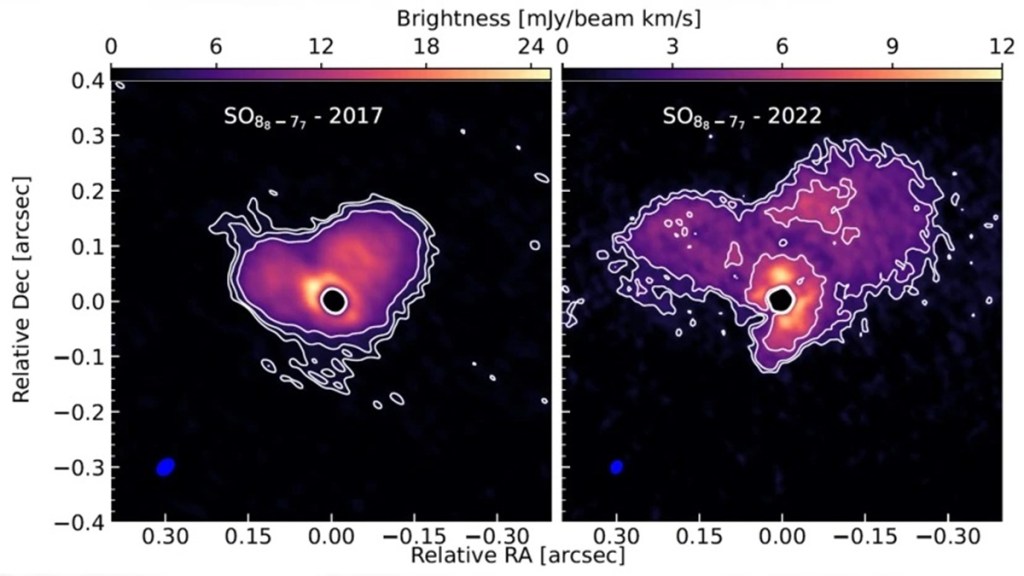
Mira A—which has been known to astronomers for more than 400 years—is part of a binary star system, along with the white dwarf Mira B, in the constellation of Cetus (the Whale).
The red giant is what is known as a variable star, meaning that its surface pulsates, causing it to increase and decrease brightness over time. In fact, red giants that do this are known as “Mira variables,” after Mira A.
Khouri and his colleagues discovered material expanding out from the cloud while analyzing data collected between 2015 and 2023 by the European Southern Observatory’s Very Large Telescope and Atacama Large Millimeter/submillimeter Array, both of which are in Chile.
The team was struck by the sheer volume of material released from the star, which was around 100 times more than expected—and equivalent to seven times the mass of Earth.
“We know that stars like Mira lose mass as they age, but we did not expect it to happen in such large and sudden bursts,” said Khouri.
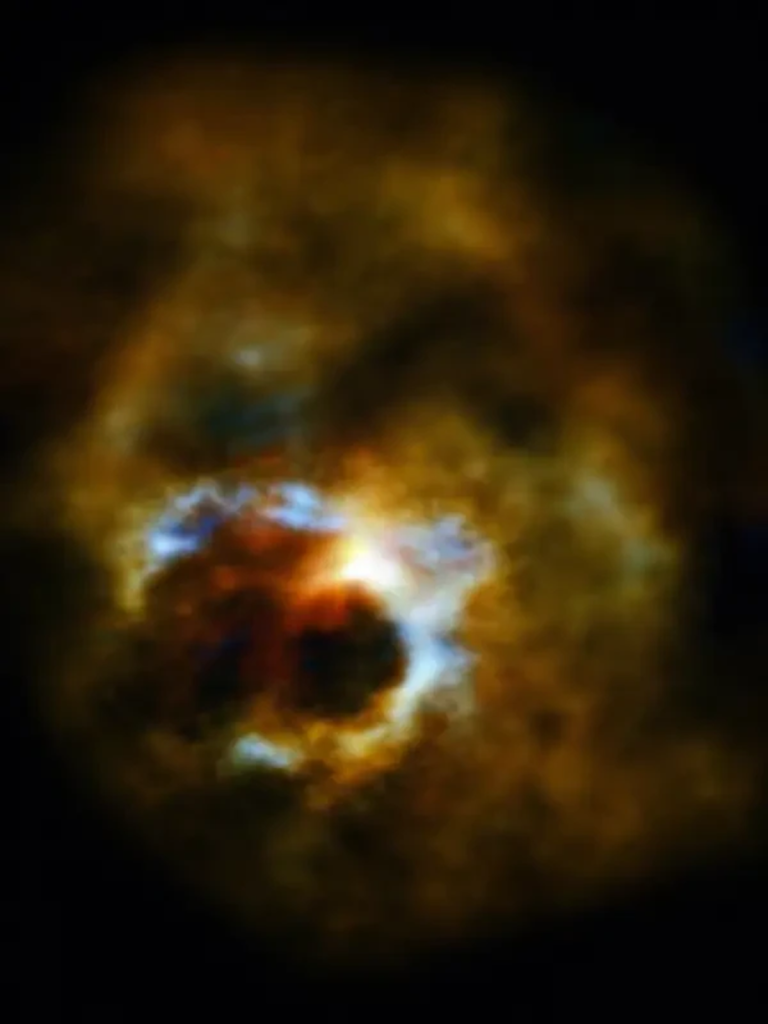
Observations taken at both visible light and infrared frequencies revealed how two plumes are creating the heart-shaped cloud, which is filled with gas but has dust concentrated along its outside edges.
“We will keep monitoring the expanding cloud around Mira A, as it is becoming so large that it may start to affect its companion star, the white dwarf Mira B,” said Khouri.
“It is already gathering some of the material ejected by Mira A.”
Understanding how Mira A is losing mass is providing new insights into how aging stars evolve—and end up shedding material that can later become the building blocks of new star systems.
Key Details About Mira A and Its Heart-Shaped Cloud
- Location: Mira A is located approximately 300 light-years from Earth in the constellation Cetus.
- Binary System: It is part of a binary system with Mira B, a white dwarf star.
- Variable Star: Mira A is classified as a "Mira variable" due to its pulsating surface, which causes fluctuations in brightness.
- Discovery Period: The research was based on data collected between 2015 and 2023 using advanced telescopes in Chile.
- Mass Ejection: The amount of material ejected by Mira A was about 100 times greater than expected, equivalent to seven Earth masses.
Implications of the Discovery
The discovery of the heart-shaped cloud has significant implications for understanding stellar evolution. As stars age, they often shed mass through various processes. However, the scale and suddenness of Mira A’s ejection were unexpected. This event offers scientists a unique opportunity to study how stars interact with their surroundings and how these interactions influence the formation of new celestial bodies.
The team of researchers led by Theo Khouri continues to monitor the expanding cloud, as it could soon impact the white dwarf Mira B. This interaction might provide further clues about the dynamics of binary star systems and the role of mass loss in stellar life cycles.
Future Research and Observations
- Monitoring: Continued observation of the cloud is essential to track its expansion and potential effects on Mira B.
- Data Analysis: Researchers will analyze the composition of the cloud to understand the types of materials being ejected.
- Modeling: Simulations may be used to predict how the cloud might evolve over time and how it interacts with the surrounding space.
This discovery highlights the beauty and complexity of the universe, where even the most ancient stars can create stunning and unexpected phenomena. The heart-shaped cloud serves as a reminder that science and romance can coexist in the vast expanse of space.
