The Love That Sparked a Discovery
The Romantic Origins of the Telephone
The story of the telephone is one of passion, rivalry, and an unexpected twist of fate. It all began in a seemingly unromantic setting: the United States Patent Office on February 14, 1876, which was anything but a Valentine’s Day dream. Amid the usual hustle and bustle of clerks working in the federal building, a dramatic tale unfolded that would shape the future of communication.
At the center of this story was Alexander Graham Bell, a Scottish inventor whose work would change the world. His lawyer, determined to secure a patent for his invention, pushed for immediate registration. The stakes were high—owning the rights to a working telephone system promised immense wealth, and time was of the essence as others were also in the race.
Among the competitors was Antonio Meucci, an Italian immigrant, and Elisha Gray, an American who had filed a caveat for a similar device. However, Gray arrived too late, as Library of Congress records show he was the 39th entry that day while Bell was fifth. This small difference in timing proved crucial, as it allowed Bell to secure the patent first.
Bell's success led to the creation of the Bell Telephone Company, which later became AT&T. The patent, numbered 174,465, was awarded the following month and became one of the most lucrative in history. Within a year of its demonstration at the Centennial Exposition in Philadelphia, the telephone had taken off, with sales jumping from 100 pairs to 778 in just a month.
Bell's vision extended beyond just the technology. He believed in the power of communication, stating, “A man in one part of the country may communicate by word of mouth with another in a distant place.” His dream has since evolved into the modern era of mobile phones and smartphones, enabling billions to connect across the globe.
Despite his success, Bell faced legal challenges. Elisha Gray and Antonio Meucci both claimed to have invented the telephone before him. Gray went to court multiple times, but Bell won all 587 lawsuits, including five in the Supreme Court. Meucci, who had developed a telephone system in 1855, could not afford the $250 required to patent it and died before his case was resolved.

Bell's journey was not solely about invention; it was deeply personal. Born in Edinburgh in 1847, he had a fascination with sound and communication. His father, Alexander Melville Bell, was a leading elocutionist, and his mother, Eliza, was profoundly deaf. Bell followed in his father’s footsteps, teaching the deaf how to speak using Visible Speech, a method that relied on sight rather than hearing.
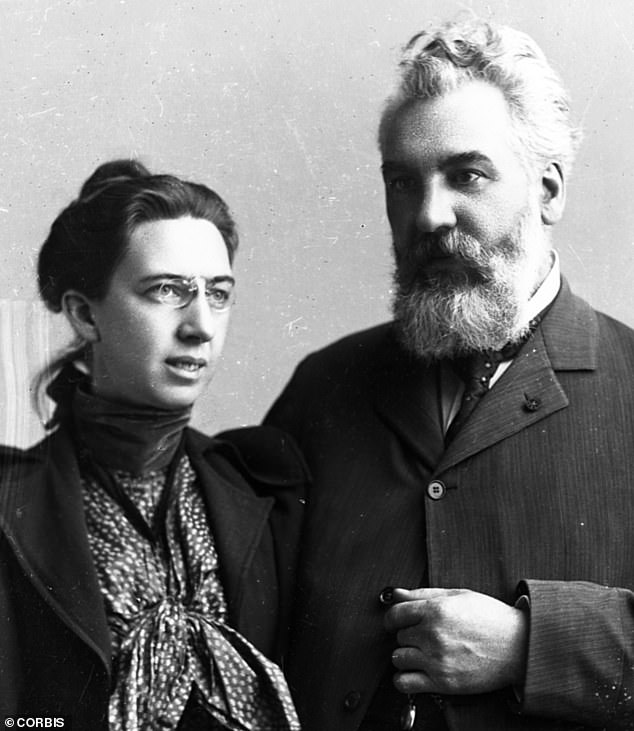
After moving to Canada and then Boston, Bell met Mabel Hubbard, a deaf teenager, and fell in love. Their relationship was initially met with skepticism, but they eventually married. Mabel’s deafness was due to a childhood illness, and their marriage lasted 45 years, producing two daughters.
Bell’s work in communications technology led to the development of the telephone. His understanding of sound and the realization that the human voice could be transmitted through continuous fluctuating currents gave him a unique advantage. By 1874, he was experimenting with “electric speech,” and by 1876, he had successfully transmitted the first intelligible sentence over the phone.
His invention not only brought him wealth but also earned him recognition from Queen Victoria, who ordered a private line between Osborne House and Buckingham Palace. By 1886, more than 150,000 people in the U.S. owned a telephone, and the first phone book was issued in New Haven, Connecticut.
Bell continued to innovate throughout his life, contributing to medical research and inventing techniques for teaching speech to the deaf. He also explored other interests, including kites, aeroplanes, and solar panels.
Bell passed away in 1922, leaving behind a legacy that continues to influence the world. Despite his fame, he refused to have a telephone in his study, considering it a distraction. Instead, he kept a photograph of Mabel on his desk, with the words “the girl for whom the telephone was invented” written on the back.
As we celebrate Valentine’s Day, the story of the telephone reminds us that even the most groundbreaking inventions can have a romantic origin.
