US Uses AI to Capture Venezuelan President Maduro Amid Maker Concerns
The Role of AI in Military Operations
Artificial intelligence (AI) is increasingly becoming a critical component in military operations, with the United States leveraging advanced tools to enhance its strategic capabilities. One such tool is Anthropic's AI model, Claude, which has been utilized in classified operations by the Department of Defense. This development highlights the growing influence of AI in modern warfare and raises important questions about its ethical implications.
Anthropic's Involvement in Classified Operations
Anthropic, a leading developer of AI models, made history by being the first company to have its technology used in classified operations by the US Department of Defense. This collaboration came after a $200 million contract was signed with the company last year. However, the developers have not confirmed whether the software was specifically used in any operation, including the mission to capture Venezuelan President Nicolas Maduro.
The company’s usage guidelines explicitly prohibit the use of Claude for facilitating violence, developing weapons, or conducting surveillance. Despite these restrictions, the operation to capture Maduro and his wife on January 3 involved the bombing of several sites across Caracas, the capital of Venezuela.
Concerns Over AI Use
A spokesperson for Anthropic stated that any use of Claude, whether in the private sector or government, must comply with their usage policies. They emphasized their commitment to working closely with partners to ensure compliance. However, the involvement of Claude in military operations has raised concerns among the company's leadership.
Chief Executive Dario Amodei has publicly addressed the power of AI and the risks it poses to society. He has called for greater regulation and guardrails to prevent potential harms from AI. His stance has put the company at odds with the Trump administration, as Anthropic has also expressed concerns about the use of AI in autonomous lethal operations and domestic surveillance.


Impact on AI Companies
Despite these concerns, the adoption of AI by the US military is seen as a significant boost for AI companies competing for legitimacy. These companies are striving to meet the high expectations set by investors. Other notable players in this space include OpenAI and Google’s Gemini, which are now used by three million US military personnel.
A custom version of ChatGPT is being utilized for analyzing documents, generating reports, and supporting research. This integration of AI into military operations underscores its growing importance in national security strategies.
The Operation to Capture Maduro
After weeks of meticulous planning and waiting for the weather to be 'perfect,' former President Donald Trump authorized Operation Absolute Resolve at 10:46 pm Eastern Standard Time on Friday, January 3. The operation took place in the early hours of the following day, with US forces reaching Maduro's home at 1:01 am EST.
Special Forces troops entered Maduro's heavily guarded compound using a technique known as 'fast roping'—deploying rapidly from helicopters by sliding down ropes. They faced heavy gunfire but managed to capture Maduro and his wife within minutes.
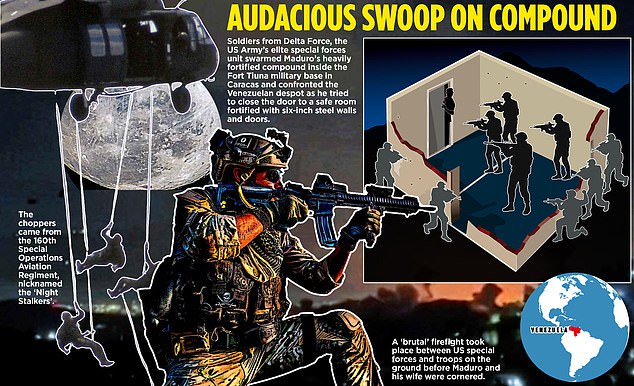
The entire operation, including the ground firefight and capture of Maduro, took less than 30 minutes. US forces returned to the USS Iwo Jima by 3:29 am, marking a swift and successful military action. This event highlights the evolving role of technology, including AI, in modern military strategies and operations.
