Uzbekistan Boosts Pediatric Surgery Capabilities Locally
Advancements in Medical Technologies in Uzbekistan
In 2025, Uzbekistan made significant strides in integrating advanced medical technologies into its healthcare system. According to data from national health authorities, artificial intelligence (AI) was utilized in 43 types of medical procedures by November. Additionally, 179 new diagnostic methods and 199 treatment techniques were introduced in specialized medical centers.
At the regional level, healthcare facilities were performing 379 types of rare and complex surgical operations. These developments have enhanced the country's ability to treat complex pediatric conditions locally, reducing the need for children to be referred abroad for specialized care.
National Children’s Medical Centre: A Hub for Advanced Care
Bakhtiyorjon Umarov, Head of the National Children’s Medical Centre, emphasized that the institution was established to centralize advanced pediatric services. The facility not only employs doctors and nursing staff but also technical specialists responsible for operating and maintaining sophisticated medical equipment.
The centre has achieved international accreditation from a US-based accrediting body after meeting approximately 1,200 clinical and operational standards. It is among about 1,000 medical institutions worldwide with this accreditation and is the first standalone pediatric facility to do so.
A variety of advanced procedures have been conducted at the centre, including bone marrow and liver transplants, laparoscopic kidney transplants, and the isolation of stem cells from peripheral blood.
Umarov noted that multidisciplinary teams comprising surgeons, anesthesiologists, intensive care specialists, nurses, and laboratory staff completed training programs in Russia, Belarus, Türkiye, China, and South Korea before introducing several advanced procedures.
Transplantation and Oncology Care
Uzbekistan performed its first pediatric liver transplantation on a seven-month-old infant using a living donor. Two liver segments were transplanted from the child’s mother, with both donor and recipient showing stable post-operative recovery.
Previously, children with congenital liver disorders, such as malformations of the biliary tract, had to be referred abroad for transplantation. Even when a living donor was available, treatment overseas typically cost over $50,000. Now, these procedures are available domestically.
Bone marrow transplantation has also been introduced as a treatment option for children with hematological and oncological diseases. This method is used when conventional therapies are insufficient, allowing for the replacement of malignant or damaged blood-forming cells with healthy stem cells.
Around 40 bone marrow transplantations have been conducted at the National Children’s Medical Centre. In cases where related donors were incompatible, haploidentical stem cell transplantation using unrelated donors was applied. Comparable procedures abroad usually cost between $100,000 and $250,000.
Under the national healthcare policy, medical services for children under the age of 18, including high-technology surgical procedures, are funded by state resources.
Neurosurgery and Neonatal Care
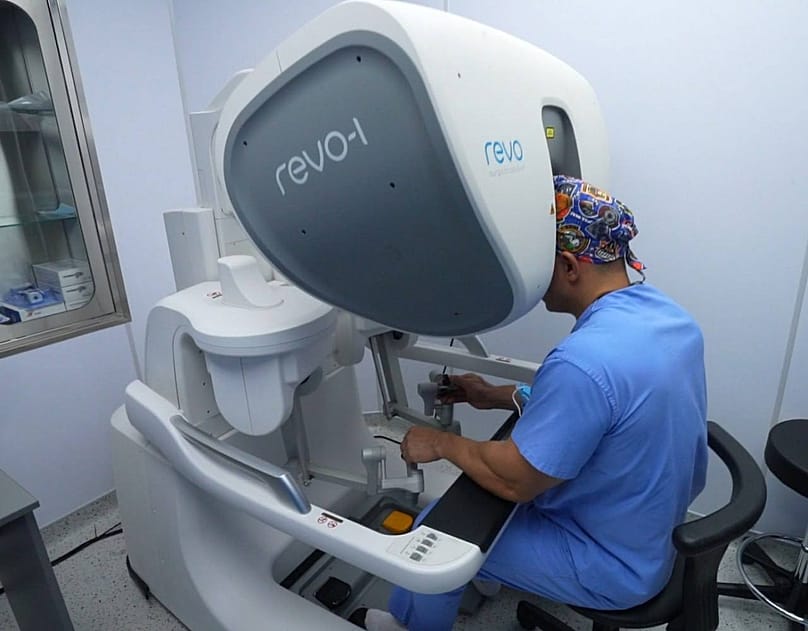
At the Republican Specialised Scientific and Practical Centre for Neurosurgery, robot-assisted and navigation-guided systems have been introduced for selected procedures, including surgery for deep-seated brain tumors and pharmacoresistant epilepsy.
In one reported case, a six-month-old infant experiencing seizures unresponsive to medication underwent surgery using robotic assistance. Surgeons identified and removed the epileptogenic focus, and post-operative monitoring indicated that seizures had ceased.
Separately, conjoined twins born prematurely at 33–34 weeks were separated during an emergency operation at the Tashkent regional branch of the Republican Specialised Mother and Child Health Centre in Chirchik. The surgery was conducted around nine hours after birth by local specialists.
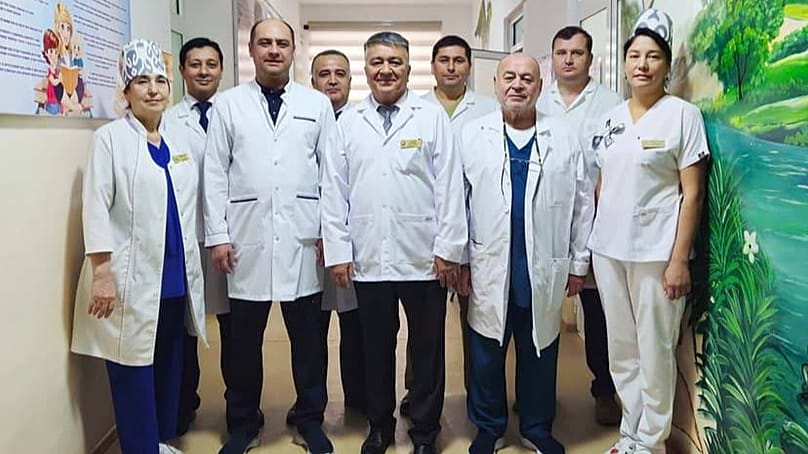
The twins shared sections of the intestine and urinary bladder, increasing the complexity of the procedure. According to Professor Bakhtiyor Ergashev, Head of the Neonatal Surgery Centre at the Republican Perinatal Centre, the operation was particularly challenging due to the infants’ premature condition and shared internal organs. He stated that the procedure required a high degree of precision, especially after rupture of connective tissue following birth, which caused fluid leakage from the abdominal cavity.
Similar operations had previously been carried out in Uzbekistan on two occasions, one involving foreign specialists and another involving foreign patients, Ergashev said.
