Von der Leyen Condemns NATO Chief's 'No Security Without US' Statement, Urges European Defense Unity
A Strong Statement on European Security
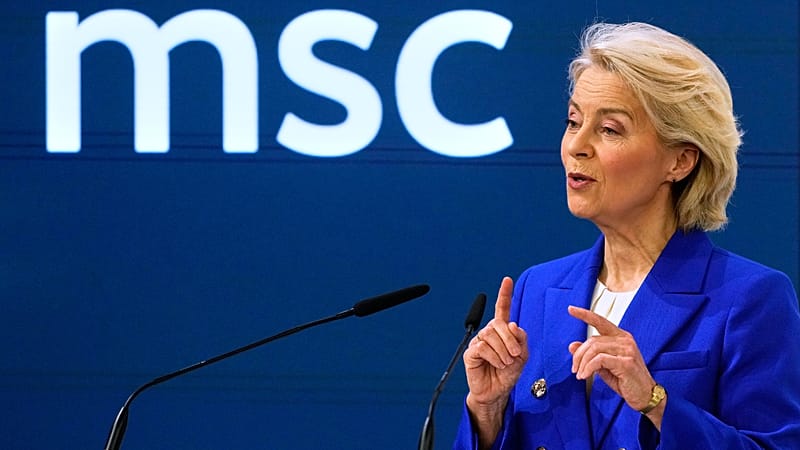
At the Munich Security Conference, Ursula von der Leyen, President of the European Commission, directly addressed the head of NATO, challenging his assertion that Europe can "keep on dreaming" about achieving independence in its security. She emphasized that the security landscape in Europe is more complex than it appears and urged European leaders to take action to reinforce mutual defense commitments among EU nations.
Von der Leyen stated, "I believe the time has come to bring Europe's mutual defence clause to life." She highlighted that mutual defense is not optional for the EU but an obligation. While most EU countries are also NATO allies, the bloc’s founding treaties include a mutual defense clause under Article 42.7, which has remained largely unused until now. Since the return of President Donald Trump, there has been a push to define what European mutual defense entails more clearly.
The European Commission president also responded to NATO Secretary General Mark Rutte’s comments that Europe cannot guarantee its security without the United States. She said, "My dear friend, there is not only status quo goes on or division and disruption. There's a lot in between and status quo is not satisfactory, neither for us nor the US."
She added, "Let’s develop our strength without constantly leaning on someone else." This statement reflects her belief that Europe must take greater responsibility for its own security rather than relying solely on external support.
The Debate Over European Defense
Rutte had previously sparked controversy by stating that "if anyone thinks here, again, that the European Union, or Europe as a whole, can defend itself without the US, keep on dreaming. You can't. We can't. We need each other." He argued that European nations would need to spend 10% of their GDP on defense, rather than the current target of 5%, to compensate for the loss of Washington's backing.
"You'd have to build up your own nuclear capability. That costs billions and billions of euros," he said. "In that scenario, you would lose the ultimate guarantor of our freedom, which is the US nuclear umbrella. So, hey, good luck!"
Von der Leyen countered that Europe is already making progress in defense spending, with nearly 80% increase since the start of Russia's war against Ukraine. However, she stressed that spending alone is not enough. "No taboo can go unchallenged," she said, emphasizing the need for Europe to strengthen its capabilities and trust.
Article 42.7: The Mutual Defense Clause
Article 42.7 of the EU treaties states that "if an EU country is the victim of armed aggression on its territory, the other EU countries have an obligation to aid and assist it by all means in their power." This clause has only been triggered once, following the 2015 terrorist attacks in Paris, and is generally considered weaker than NATO’s collective defense clause.
Under NATO, if one ally is attacked, the rest would come to its defense, including the United States. Twenty-three of the EU’s 27 members are also part of NATO.
Von der Leyen emphasized that this commitment must be built on trust and capability. She called for the EU to make decisions faster, suggesting that using a qualified majority rather than unanimity could help achieve this goal. "We do not need to change the Treaty for this. We need to use the one we have," she said.
Strengthening Partnerships and Collaboration
Von der Leyen also advocated for the EU to be more creative in its approach to security, highlighting partnerships such as the UK-led Joint Expeditionary Force and the Coalition of the Willing for Ukraine. "What we need to do now, is formalise the ad hoc beginnings of new security collaborations," she said.
She emphasized the importance of working closely with key partners like the UK, Norway, Iceland, and Canada. "We want to increase our offer to many of these vital partners. This means, in this acutely volatile time, Europe and in particular the UK should come closer together – on security, on economy or on defending our democracies."
British Prime Minister Keir Starmer echoed this sentiment, stressing the urgency of rekindling relations with the EU after Brexit. "This is of some urgency, because I think that on defence and security, until the Ukraine conflict we didn’t really wake up the reality that we’re facing," he said.
A Call for Independence Across All Sectors
Beyond defense, von der Leyen warned that Europe must become independent across various sectors, including energy and technology. "There is no other choice," she said, highlighting the challenges to the European way of life and democratic foundations.
She also addressed concerns over digital regulations, stating, "Our digital sovereignty is our digital sovereignty" and that the EU will not compromise on this issue. "I want to very clear: our digital sovereignty is our digital sovereignty," she reiterated, signaling the EU's determination to maintain control over its digital policies.
