What is Latam-GPT? The AI Model for Spanish and Portuguese in Latin America
A New Initiative for Latin American AI
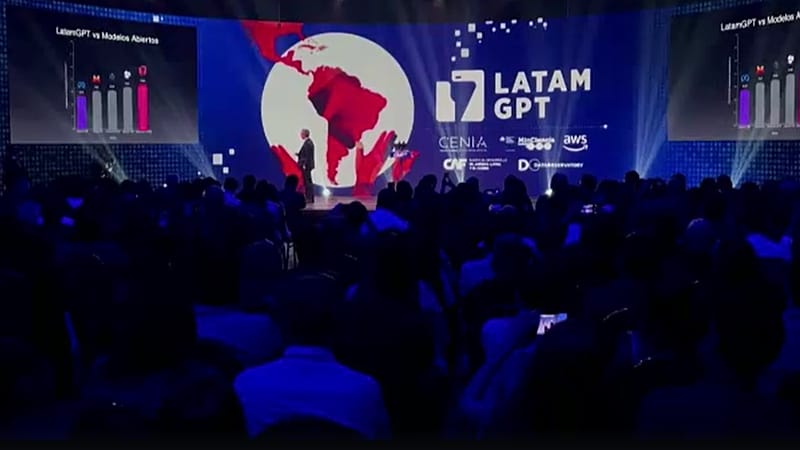
Chile has introduced a groundbreaking project called Latam-GPT, which aims to provide Latin America with its own artificial intelligence (AI) model. This initiative seeks to address the dominance of American companies in the AI sector and reduce the biases present in existing systems. The project is being led by Chile's National Centre for Artificial Intelligence (Cenia), a private organization with public funding. It has also received support from various universities, foundations, libraries, governmental entities, and civil society organizations across several Latin American countries, including Chile, Uruguay, Brazil, Colombia, Mexico, Peru, Ecuador, and Argentina.
President Boric Highlights Regional Importance
During the project's presentation on Television Nacional, Chilean President Gabriel Boric emphasized the region's role in global technological development. He welcomed the fact that Latam-GPT will allow Latin America to become an active participant in the economy of the future. The Chilean Minister of Science, Aldo Valle, stated that the tool aims to break down prejudices and prevent the representation of Latin America from becoming homogeneous. According to Valle, the region should not be a passive user or recipient of AI systems developed elsewhere, as this could lead to the loss of part of its cultural traditions.
Understanding Latam-GPT
Despite its name, Latam-GPT is not an interactive chat system. Instead, it is a large database trained on information from the region, designed to serve as a foundation for developing technological applications. The development of large AI models has largely been concentrated in the United States, China, and Europe. In addition to Latam-GPT, other regional initiatives have emerged, such as SEA-LION in Southeast Asia and UlizaLlama in Africa, each focusing on their unique cultural contexts.
Funding and Development
To train Latam-GPT, more than eight terabytes of information have been collected, equivalent to millions of books. The model was created with a budget of $550,000 (over €460,000), primarily funded by the Development Bank of Latin America (CAF), along with resources from Cenia and agreements with other institutions. The first version of the system was developed on Amazon Web Services cloud. In the future, the model will be trained on a supercomputer to be installed at the University of Tarapacá in northern Chile during the first half of 2026, with an investment of nearly five million dollars.
Addressing Cultural Representation
Alvaro Soto, director of Cenia, noted that models developed in other regions often include only a small proportion of Latin American data. During the launch, President Boric highlighted this disparity by comparing the extensive information available on the siege of Calais with the limited coverage of key battles of Chilean independence, such as the siege of Chillán. At this stage, the content of the model is mainly in Spanish and Portuguese, but there are plans to incorporate indigenous languages in the future.
Academic Concerns
However, academic Alejandro Barros from the University of Chile has warned that Latam-GPT may not be able to compete with global AI models due to differences in economic resources and infrastructure.
Potential Applications
Latam-GPT will be a free platform and could be used to develop tools tailored to local needs, such as digital solutions for hospitals facing logistical challenges or the efficient use of medical resources. One of the first companies to use the model will be Chile's Digevo, which will develop conversational robots specializing in customer service for airlines and retail companies. According to its director, Roberto Musso, these companies have shown interest in having users express themselves and receive answers in the local language. Musso added that Latam-GPT can recognize slang, idioms, and even speech speed, helping to reduce bias issues that can occur in other AI models.
