Woochang Conecta, suspected of 'planned bankruptcy' through debt relief for the parent company... all employees fired two hours before leaving work
[HBN News = Hong Sogi reporter] Uchanga Conecta, an auto parts company in Cheonan, Chungcheongnam-do, went bankrupt six years after acquiring its parent company Mobis (Mobis Electronics), leaving significant damage to workers, subcontractors, and the local community, while suspicions are growing that it was a "planned bankruptcy for debt relief."
According to the Democratic Trade Union Confederation's Sejong-Chungcheong Regional Headquarters on the 13th, the union and the laid-off workers filed an immediate appeal against the court's bankruptcy declaration, arguing that "Mobius had planned to shut down operations and lay off all employees for years, designed assets and transaction structures, and abused the bankruptcy procedure."
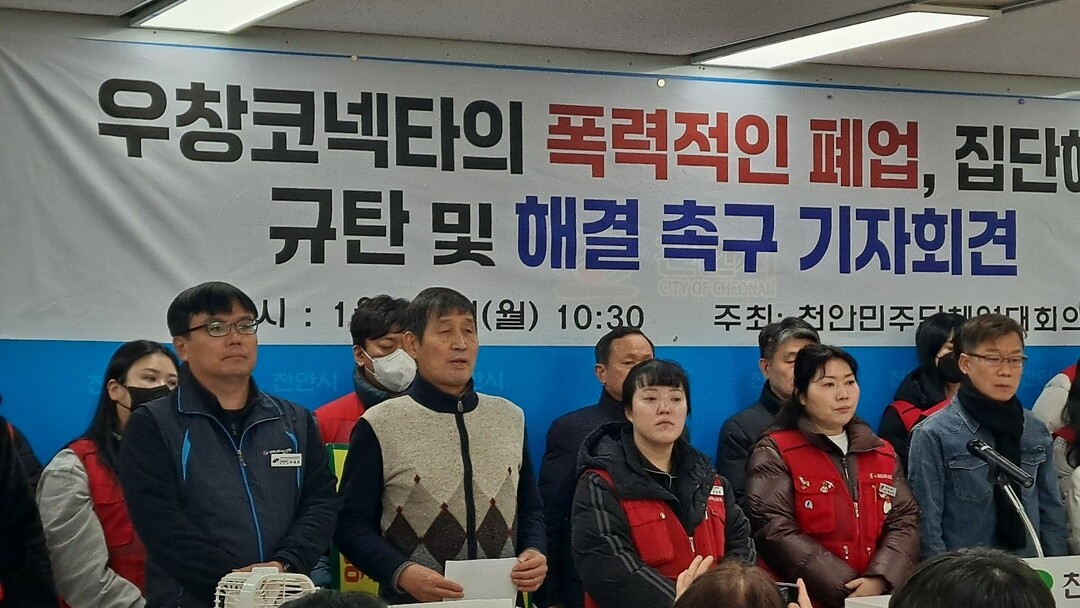
Workers of Uichang Conecta testified that the company effectively announced bankruptcy through an "overnight ambush" method. On the 22nd of last month, after the court's bankruptcy ruling, the company's representative reportedly came to the site and announced, "You are fired, so everyone must leave within one hour."
More than 80 workers at Uchanga Conecta, mostly in their 40s with an average of 10-30 years of service, are now facing a situation where their livelihoods are collapsing. The company has a legal obligation to pay retirement benefits, but due to the bankruptcy proceedings, these payments are being pushed to the end of the priority list, meaning a significant portion could be lost. According to court records and information obtained by the union, the debts to be settled due to Uchanga Conecta's bankruptcy include 6.8 billion won in bank loans, 270 million won in national taxes, 660 million won in factory rental fees, 4.4 billion won for goods from more than 60 subcontractors, and 4.8 billion won in wages and retirement benefits.
However, the actual liquid assets amount to only about 600 million won, so only the Industrial Bank, which has a mortgage, and some preferred bonds are expected to recover somewhat, while the shares of cooperating companies and workers are likely to be significantly reduced.
◆ "Profitable company, debt ratio 5560% after 6 years of acquisition...Sale of core assets and cost of sales 106%"
The basis for the union and laid-off workers' allegations of "planned bankruptcy" is the changes in financial structure before and after the acquisition of Mobis, as well as the transaction and asset transfer structures between affiliated companies.
According to the data from the Democratic Trade Union Confederation's Sejong-Chungcheong Branch, as of 2018, Uchanga Konekta was a mid-sized automotive parts company that had been consistently profitable every year. The debt ratio before the acquisition was around 130%. However, after Mobis acquired the company in 2019, the debt ratio sharply increased to 270%, rose to 5560% in 2022, and since 2023, it has completely fallen into capital insolvency. In particular, after Mobis acquired the company, Uchanga Konekta sold one of its core assets that had previously generated stable profits, resulting in a loss of 910 million won from the disposal. Additionally, the cost of sales ratio for supplies to Mobis and a specific supplier (Company A) rose as high as 106%, creating a structure where losses were incurred with each sale. This is in contrast to the pre-acquisition cost of sales ratio, which remained around 95%. In other words, it is being pointed out that losses and debts are concentrated on Uchanga Konekta due to the transaction structure between the parent company and subsidiaries, as well as the asset disposal plan, while the parent company secures key assets such as core equipment and molds, leaving the bad debts and liabilities to the subsidiary. This is considered a typical "risk separation" structure.
◆Industrial Bank's mortgage - asset sale - filing for bankruptcy: "smooth and straightforward"
The movements in the months before bankruptcy have fueled suspicions of a "planning" scheme. According to documents provided by the union, in December last year, the Korea Development Bank set up a mortgage on the entire Wuchang Conecta factory. After that, Wuchang Conecta sold core production assets such as molds and manufacturing equipment to the parent company.
On December 29 of the same year, after such asset transfers were completed, Wu Chang Konecta's board of directors applied for bankruptcy to the court, and on January 22, less than a month later, the court declared bankruptcy. The union criticized, "The actual amount that can be converted into cash is about 600 million won, but after excluding the 290 million won mortgage from the Industrial Bank, 100 million won for three years' retirement benefits, and 100 million won in priority claims such as taxes, the rest is only about 100 million won." "Although a significant portion of the debts will be resolved, the result for workers and subcontractors is essentially an announcement of closure." Such actions have raised strong suspicions that the subsidiary was intentionally collapsed for debt restructuring, going beyond the legally permissible scope, through the following processes: ① securing preferential collateral from policy financial institutions, ② transferring core equipment to the parent company, and ③ immediately filing for bankruptcy and receiving a swift court ruling.
◆ Immediate appeal by laid-off workers: "False loan extension and malicious acts, abuse of bankruptcy procedures"
The 65 employees laid off by Wuchang Conecta submitted an immediate appeal to the Daejeon District Court on May 5, protesting the bankruptcy ruling. The appeal stated that the parent company, Mobes Technologies, had "planned to shut down operations and lay off all employees several months ago." The workers claimed that "under this plan, they obtained a loan extension through false means, and provided all the factory land and equipment as collateral to the Korea Development Bank, making it difficult for other creditors to recover their debts."
Also emphasizing that "this case's debtor can only be seen as misusing the bankruptcy procedure, and the bankruptcy ruling should be revoked," they pointed out that the company violated previous employment maintenance agreements, and initiated the bankruptcy process secretly without prior consultation or discussion on countermeasures. The Seoul-Choongcheong Branch of the Korean Confederation of Trade Unions and the laid-off workers publicly criticized that "the financial situation of Uchanga Konekt, which had been profitable every year, rapidly deteriorated after the acquisition by Mobaisu," adding that "Mobaisu capital planned for bankruptcy from the time of acquisition, and over six years, took everything from its subsidiaries, then carried out a planned bankruptcy to get debt relief."
◆ Parent company, Industrial Bank, and local governments all remain silent... revealing a regulatory blind spot
Unions and workers held a press conference in front of the Suwon City Hall, demanding administrative investigations and enhanced management and supervision of the Mobis Suwon factory.
However, Mobais is not responding to the request for confirmation, and the city of Suwon and Gyeonggi Province have also not yet presented specific investigation plans or measures to strengthen supervision.
It is difficult to avoid the accountability of the state-owned financial institution, the Korea Development Bank. After setting a lien on the entire Wuchang Konecta factory on its own and then proceeding with bankruptcy, the Korea Development Bank found its chances of recovering debts relatively higher, while the shares of other private creditors, suppliers, and workers sharply decreased.
While this can be explained as a conventional measure for debt preservation, it is difficult to avoid criticism that this approach, which focuses guarantees only on subsidiaries already in a state of capital erosion, ultimately results in "saving the parent company and major shareholders" at the expense of "subcontractors and workers."
Issues such as how Mobis designed asset sales and inter-subsidiary transactions after acquiring U-Chang Connect, how much the Korea Development Bank was aware of this structure when setting up collateral, and whether Suwon City and Gyeonggi Province failed to take action despite prior awareness of the deterioration of the factory and employment situation will inevitably become key points of contention in the future.
◆ Repeating "Bankruptcy within the legal framework" system
The issue is particularly problematic in that, even if all the currently revealed circumstances are true, there remains a possibility that a significant portion of it could be argued to have been carried out "within the framework of the law" under the current legal system.
The structure involves transferring the subsidiaries' bad debts and liabilities, moving core facilities, molds, and clients to the parent company or other affiliated companies, and first addressing the interests of priority lien holders, then wiping out personnel costs, severance pay, and supplier debts all at once through the subsidiary's bankruptcy. This pattern resembles the "looting-type acquisition and subsequent cleanup" that has repeatedly been criticized in the Korean business community.
Such structural adjustments have been tolerated as a sort of "legal option" within bankruptcy law, company law, and insolvency procedures, unless intentional misconduct or illegality is clearly proven.
However, as seen in the case of WuChang Connect, in practice, the parent company, major shareholders, and some financial institutions minimize their losses, while the cost is borne by workers, contractors, and the local community through "regressive restructuring" that is repeatedly imposed.
From the perspective of the capital market and corporate governance, this is a clear case of moral hazard and failure in institutional design.
The court that issued the bankruptcy ruling also needs to strengthen its system to actively examine not only the financial statements of subsidiaries, but also the transaction and asset transfer records of the parent company and affiliated companies, and to check for any abuse of the bankruptcy procedure.
In particular, since workers directly raised the issues of "abuse of bankruptcy procedures" and "fraudulent acts" through immediate complaints, it is pointed out that more thorough judicial verification regarding the parent company's responsibility and whether the bankruptcy was planned should be conducted in future complaint reviews.
