British drones target 'Russian' forces in war drills
Revolutionary Drone Swarming Technology Demonstrated in the UK
Britain has made a significant breakthrough in military technology by showcasing its advanced drone swarming system for the first time. The demonstration involved simulating strikes on a Russian tank, highlighting the potential of this cutting-edge innovation.
The drones, powered by artificial intelligence, operate using a “hive mind” approach. This means they can scan their surroundings to identify and attack targets autonomously. The development was completed in just four months by a group of British defense companies, signaling a rapid advancement in warfare capabilities that could soon be integrated across the Armed Forces.
This initiative is part of a broader effort by the Ministry of Defence (MoD) to keep pace with the fast-evolving drone technology landscape. Ukraine has been leading the way in utilizing such technologies, prompting the UK to accelerate its own developments.
Guy Hennings Haahr, land systems lead for Applied Intuition UK, emphasized the importance of this shift: “This is the direction of travel. We need to achieve mass lethality and critically, to remove soldiers from vulnerable parts of the battlefield.”
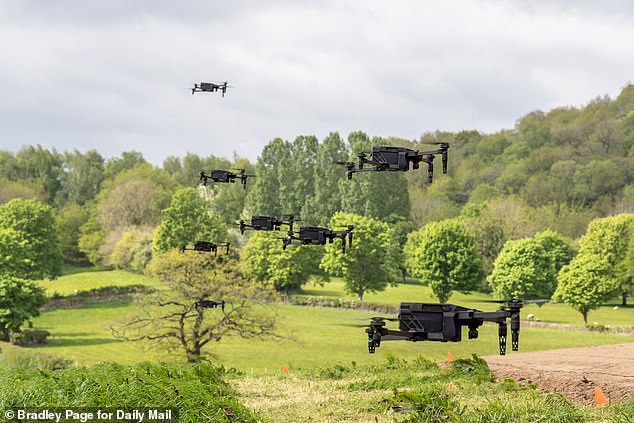
Drones have become a common sight on the frontlines of eastern Europe, and according to Mr Hennings Haahr, China is likely ahead of the UK in terms of technological advancement. He expressed concern about the rapid pace of change and the capabilities demonstrated by adversaries, stating, “We need to stay on the front foot.”
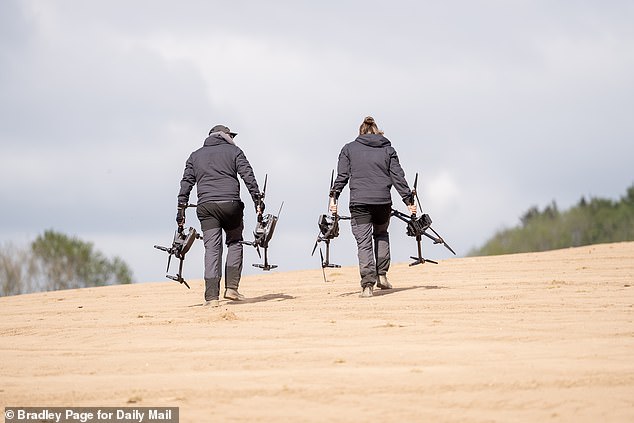
The Daily Mail recently observed eight quadcopters take off in Usk, Monmouthshire. While this was a small-scale demonstration, the software has the potential to power swarms involving hundreds of drones in the future.
During the display, two drones scouted the area for targets, including an inflatable T-90 battle tank, a BTR-80 armoured personnel carrier, and a Grad rocket system. Once identified, the drones alerted their handlers, who then granted permission for them to attack.
The technology, developed by Applied Intuition UK, is autonomous. Drones gather information about their surroundings, communicate with each other, and act accordingly. However, under international law, they require sign-off from a human before using lethal force.
Applied Intuition maintains that this requirement will remain in place. Nevertheless, the use of AI for killings has sparked debate and controversy.
Iain Lamont, head of Applied Intuition, described the evolution of warfare as inevitable. “This feels different because it’s operated from behind a screen. But we’ve gone from being toe to toe with spears, to machine guns, and so on,” he said.
Mr Lamont, a former colonel with 24 years of service, highlighted the changing perception of drones. “People almost viewed drones as toys, or trinkets, on the battlefield. But the rate of change we've seen in Ukraine has been eye-watering.”
He pointed out the significant casualties caused by drones in Ukraine, where they have accounted for more than 90% of casualties at certain points during the war. AI has become essential in Ukraine’s fight, not only through drones but also unmanned ground vehicles (UGVs), which are regularly used to rescue wounded soldiers and deliver supplies.
In the first quarter of this year, UGVs were used in over 21,000 missions in Ukraine—missions that would have previously required human involvement.
Applied Intuition has conducted over 200 test flights of its swarming technology. In February, the company won a contract to refine the UK’s swarming capabilities from the Defence and Science Technology Laboratory (DSTL). The first phase of the project is complete, and the company is awaiting further funding.
The Government’s defence investment plan (DIP), which was due to outline how funding would be allocated last autumn, has faced delays. A dispute between the MoD and the Treasury has left many firms in uncertainty.
“It is not trivial to develop drone swarming,” Mr Hennings Haahr stated. “It takes a lot of time and skill. As far as we’re concerned, we’re not here to do science experiments. We’re here to field capability into the hands of the warfighter. In order to do that we need investment. We need the DIP to be published.”