How Pappy Gunn Transformed Bombers into Naval Weapons
The B-25 Mitchell: A New Approach to Air Warfare
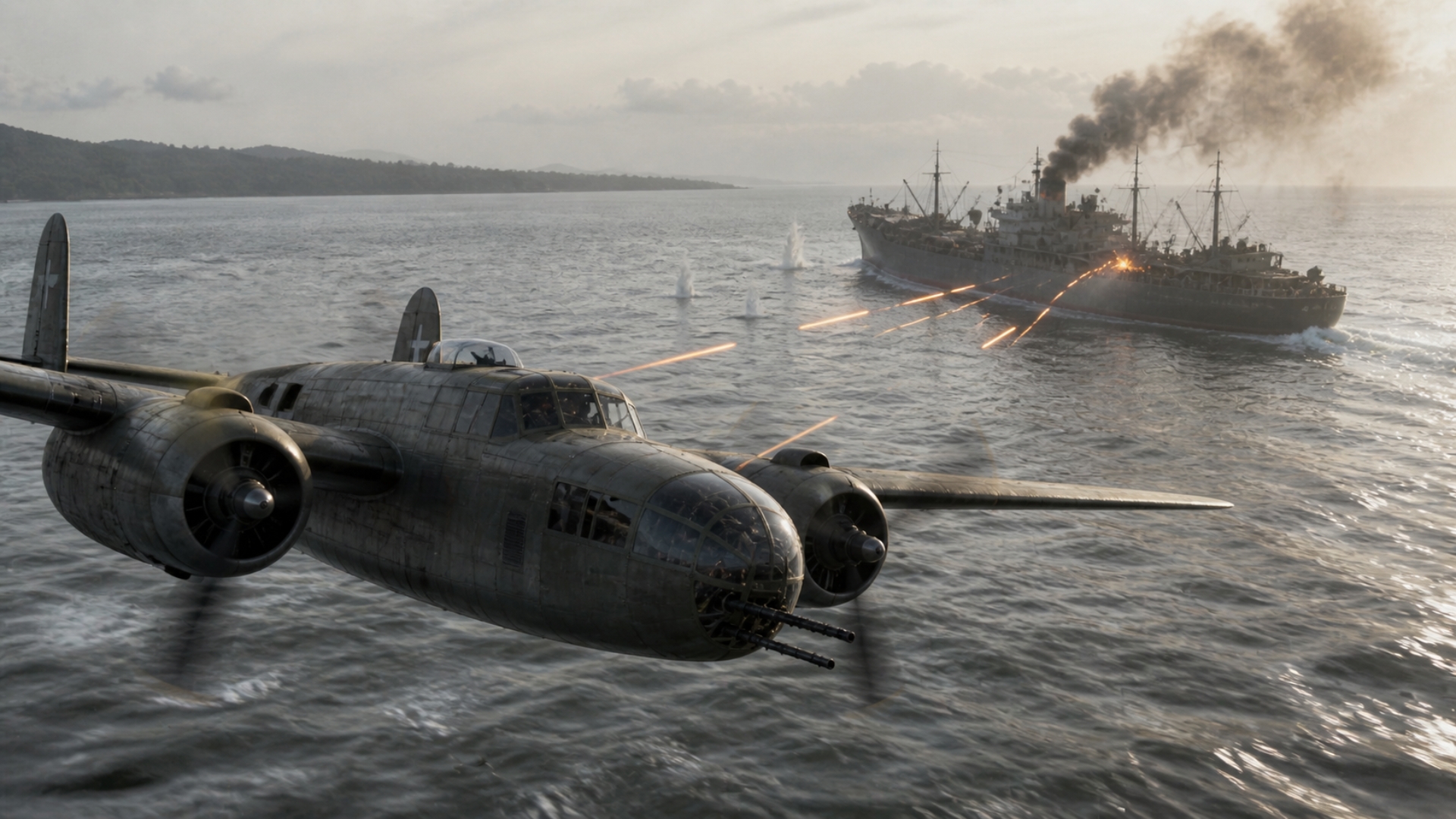
Just after dawn on March 3, 1943, a group of B-25 Mitchell bombers took off from Port Moresby for a mission that was unlike anything they had been designed for. These aircraft were originally medium bombers, meant to carry bombs, fly toward a target, release their payload, and then retreat. However, these planes had undergone significant modifications. Their glass noses had been replaced with solid metal, and heavy machine guns were installed in positions where bombardiers once worked. Additional guns were added along the sides, transforming them into something more akin to attack aircraft.
Their objective was a Japanese convoy moving through the Bismarck Sea toward New Guinea. If this convoy reached Lae, it would deliver vital troops, supplies, and momentum to a campaign that the Allies were struggling to contain. Stopping the convoy was essential.
The man behind many of these modified aircraft was not a well-known designer or a high-ranking officer. It was Paul Irving Gunn, affectionately known as “Pappy,” a former Navy enlisted aviator whose true genius came from years of fixing aircraft under intense pressure.
High-Altitude Bombing Fails Against Ships
In 1942, the Fifth Air Force faced a serious challenge in the Southwest Pacific. While its crews were brave, their methods were not proving effective enough. Medium and heavy bombers often attacked ships from high altitude using techniques suited for fixed targets. However, against moving vessels, these tactics were deeply flawed. Japanese captains could watch bombs fall, maneuver their ships, and continue on their way. Bombers had to make predictable runs while facing attacks from fighters and anti-aircraft fire.
The problem was not just about equipment; it was also about doctrine. When Major General George Kenney took command of Allied air forces in the Southwest Pacific, he recognized the need for a new approach. The distances were vast, the bases were primitive, and the Japanese relied heavily on shipping to keep their forward positions supplied. Waiting for perfect aircraft from American factories was not a viable solution.
Gunn offered an alternative: making the bombers more dangerous during their approach. He had already modified A-20 Havoc light bombers by adding .50-caliber machine guns in the nose for low-level strafing attacks. Kenney then ordered similar modifications for the B-25 Mitchells, equipping them with forward-firing firepower so pilots could suppress shipboard defenses before releasing bombs.
Gunn Builds a New Weapon From Salvage and Urgency
Paul Gunn’s path to innovation was shaped by experience rather than formal engineering. He had served for years as a Navy aviator, learning aircraft from the inside out. He knew what could be stripped, moved, reinforced, or rebuilt because he had spent his career keeping machines flying under difficult conditions.
The war made this skill personal. Gunn had lived in the Philippines with his wife and children before the Japanese invasion. When Manila fell, he escaped, but his family was left behind and interned at Santo Tomas. From that point on, the war was no longer an abstraction for him. Every Japanese ship sunk and every supply line broken seemed to bring him closer to reuniting with his family.
His modifications reflected this urgency. The bombardier’s glass nose was removed, and machine guns were installed to fire straight ahead. Additional gun packs were mounted to give the pilot a heavy stream of forward fire. The goal was simple: rake a ship’s bridge and anti-aircraft positions before the bomber reached bomb-release range.
The Convoy Is Destroyed
The results of the attack were devastating. The coordinated Allied assault shattered the convoy. According to the Royal Australian Air Force’s account, the modified Mitchells—then commonly called “commerce destroyers”—were especially destructive, claiming numerous direct hits. Allied aircraft continued attacking throughout the day as ships burned, listed, and sank.
By the end of the battle, all eight Japanese troop transports and four of the eight destroyers had been sunk. Nearly 3,000 Japanese soldiers were killed, and the convoy failed in its mission. The Allies lost only a small number of aircraft in comparison.
The aftermath also included a grim and controversial phase: Allied aircraft and patrol boats attacked Japanese rescue craft, barges, rafts, and survivors. Official histories have often treated this as part of the harsh logic of preventing rescued troops from reaching New Guinea, but it remains one of the battle’s most uncomfortable elements.
The Personal War Behind the Invention
Gunn survived the war, but not without scars. He continued serving in the Pacific and was eventually wounded in a Japanese attack on Leyte in late 1944, an injury serious enough to remove him from the war. After the liberation of the Philippines, he was reunited with his family, who had survived captivity. He retired from the Army as a colonel in 1948 due to physical disability.
After the war, Gunn returned to aviation in the Philippines. On October 11, 1957, he was killed when his aircraft crashed in a storm.
His legacy is easy to understate because it was practical rather than theoretical. Gunn did not write doctrine first and build aircraft afterward. He saw that existing methods were failing, then changed the machines until the tactics changed with them.
That is why his story still matters. The modified B-25 strafers were not born from a clean design program. They came from urgency, loss, mechanical skill, and a willingness to violate assumptions that no longer fit the battlefield.
At the Bismarck Sea, those assumptions burned with the convoy.
Paul “Pappy” Gunn did not invent air power in the Pacific. But he helped make it more lethal, more direct, and more suited to the war that was actually being fought. In doing so, he showed how one mechanic-pilot with a personal stake in victory could help change the way bombers went to war.
