
Exploring Fundamental Questions Through the SNU Grand Quest
Seoul National University (SNU) recently launched the 'SNU Grand Quest' forum at its Gwanak Campus in Seoul. This initiative is aimed at addressing some of the most profound and complex questions facing humanity. The event, held on the 18th, unveiled six groundbreaking research challenges that will be tackled using the university's extensive research capabilities. These challenges are designed to push the boundaries of knowledge, even if the chances of success are uncertain.
The SNU Grand Quest project was initiated to explore fundamental questions that have significant implications for society and human existence. The selected research topics were determined through a three-day retreat discussion involving 18 SNU scholars, including Kim Bitnae, a distinguished professor in the Department of Life Sciences. Each challenge will receive annual funding of 500 million Korean won per team for up to five years, highlighting the university's commitment to fostering innovative and high-risk research.
Key Research Challenges
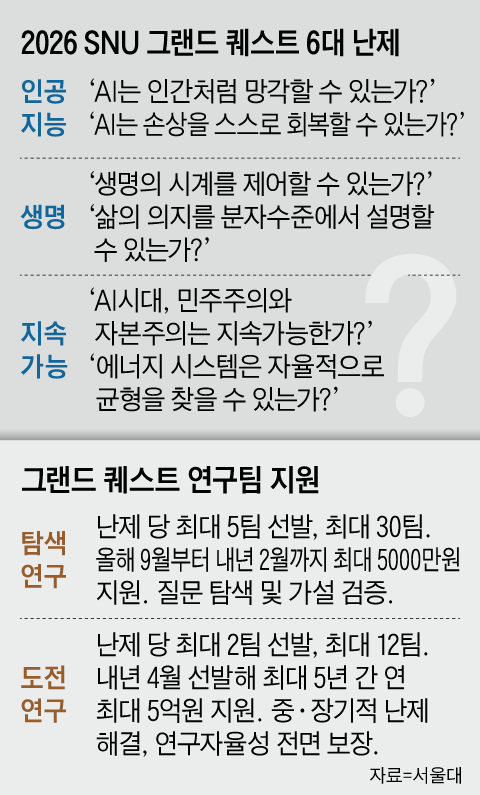
The research challenges announced by SNU span multiple disciplines, including artificial intelligence (AI), life sciences, and sustainability. Some of the critical questions include:
- Can AI forget like humans?
- Can AI self-repair damage?
- Can the clock of life be controlled?
- Can the will to live be explained at the molecular level?
- Can energy systems autonomously find balance?
- Can democracy and capitalism persist in the AI era?
These questions are not only complex but also require interdisciplinary collaboration, as they cannot be addressed by knowledge from a single field alone.
Understanding AI and Human Memory
One of the most intriguing questions is whether AI can forget like humans. Professor Lee Seok-jae of the Department of Philosophy, who contributed to this question, emphasized that forgetting is an evolutionary process that helps humans filter out unnecessary data based on context. He stated, "We must determine whether AI can independently discern context and decide what to forget and remember, just like humans." According to Professor Lee, solving this challenge requires a convergence of computer science, neuroscience, philosophy, and psychology.
The Will to Live and Molecular Levels
Another challenging question is whether the will to live can be explained at the molecular level. During discussions on depression and suicide, the focus shifted from understanding despair to exploring what makes humans rise again. Lee Jeong-dong, head of the Grand Quest Initiative Research Group and a professor at the Graduate School of Engineering, noted that there were intense debates among professors about connecting the mental domain of 'the will to live' with the physical domain of 'molecular levels.' Ultimately, the group agreed to scientifically explore the spirit that drives humans to live again.
Democracy and Capitalism in the AI Era
The question of whether democracy and capitalism can persist in the AI era is another interdisciplinary challenge. It spans engineering, social sciences, law, philosophy, and education. SNU professors formulated this question in anticipation of an era where AI may replace human economic activities and decision-making. The goal is to examine the possibility that capitalism could collapse if AI perfectly controls markets, and democracy could disappear if people delegate judgment to machines. A university official highlighted concerns that the two pillars supporting Korean society—democracy and capitalism—could crumble entirely in the AI era.
Selection Process and Funding
SNU selected the Grand Quest topics through a three-day retreat discussion in May at a hotel in Gijang, Busan, involving 18 professors, including Kim Bitnae. Humanities and social science professors also participated in the discussions. During the discussions, "feasibility of solutions" was excluded as a criterion. Hyun Taek-hwan, a distinguished professor in the Department of Chemical and Biological Engineering, emphasized that starting with feasibility would limit the potential for groundbreaking results. The focus was on creating challenges that encourage bold attempts without fear of failure.
Future Plans and Investment
SNU plans to select 30 exploratory research teams (five per challenge) starting in September. Each team will receive 50 million Korean won per month for six months. In April next year, 12 challenge research teams (two per challenge) will be chosen to develop solutions, receiving up to 500 million Korean won annually for up to five years. The university is expected to invest a total of 100 billion Korean won in this project.
Lee Jeong-dong, head of the initiative, stated, "We will not select teams aiming to solve problems through predictable methods." SNU will not require research teams participating in the Grand Quest project to submit results, even if they fail. A university official said, "Experiences and data gained during the research process will be shared with the academic community."
SNU President Ryu Hong-lim emphasized the university's vision: "SNU must become a pioneer that asks questions the world has never thought of, beyond being a model student that solves given problems well."
Additional Information
For more details on membership options and access to various publications, please refer to the following:
- Monthly membership: 5900 won, with a discounted rate of 2900 won for newspaper readers.
- Chosun Membership: Access to 8 newspapers and magazines worth 55000 won.
- Receive 7000 points to use like cash for shopping.
Komentar (0)