
There is a quiet myth in leadership that intelligence protects people from poor judgment. It sounds reasonable. We assume that the sharper the mind, the better the decision. We believe that experience, education, titles, and technical expertise naturally produce wisdom under pressure. Yet across boardrooms, executive committees, family businesses, government institutions, and fast-growing African enterprises, we see a different reality.
Brilliant leaders still approve the wrong investments. Competent executives still ignore early warning signs. Experienced founders still overestimate their capacity, underestimate risk, silence dissent, or push ahead with decisions that the organisation later pays for dearly. The uncomfortable truth is this: smart leaders do not make poor decisions because they lack intelligence. They make poor decisions because intelligence often operates inside pressure, ego, emotion, politics, incomplete information, and flawed decision processes. And when those forces are not managed intentionally, even the most capable leader can become vulnerable.
This is one of the most important leadership lessons of our time, especially in business environments where uncertainty has become normal. Across African markets, leaders are navigating currency volatility, regulatory shifts, talent migration, digital disruption, funding pressure, succession complexity, family-business dynamics, and fast-changing consumer behaviour. In these conditions, the question is no longer whether leaders are smart enough. Many are. The real question is whether their decision environment is strong enough to protect them from predictable blind spots.
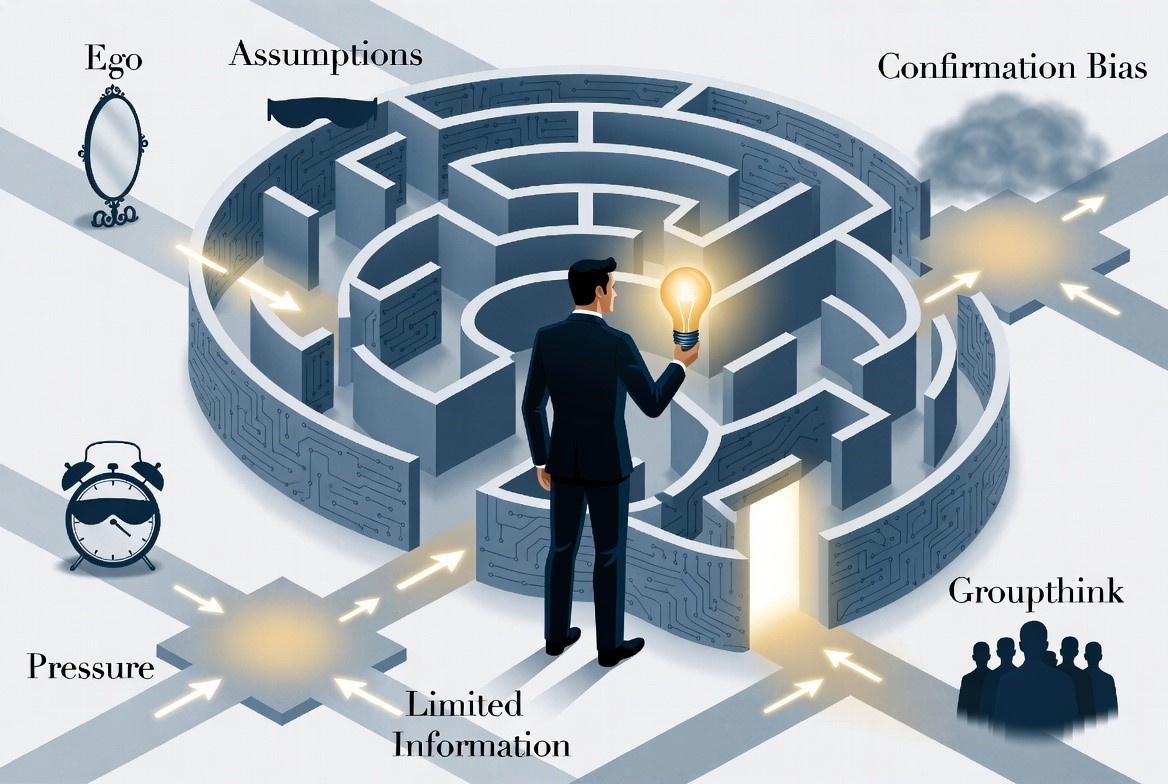
Because poor decisions rarely begin as obviously poor decisions. They often begin as confident assumptions. A leader sees what has worked before and assumes it will work again. A team avoids challenging the CEO because the room has already learned where power sits. A founder feels the emotional weight of a failing investment and keeps funding it, not because the numbers justify it, but because stopping would feel like defeat. An executive committee rushes a decision in the name of urgency, when what is really happening is discomfort with uncertainty. This is how judgment becomes distorted. Not loudly, but quietly.
The work of Daniel Kahneman and Amos Tversky helped the world understand that human beings do not always judge risk rationally. We rely on mental shortcuts. We are influenced by framing. We feel losses more sharply than equivalent gains. We often give too much weight to what is recent, visible, familiar, or emotionally charged. In leadership, these tendencies are magnified because the stakes are higher and the feedback is often delayed.
A CEO may not know for several months whether a strategic decision was sound. A board may not see the consequences of a culture decision until high performers begin to leave. A senior manager may not realise that fear has entered the room until people stop telling the truth. This is why leadership decision-making cannot be treated as a purely intellectual exercise. It is also emotional, social, cultural, and deeply human.
One of the greatest traps for intelligent leaders is the belief that bias is something other people have. Most leaders can easily identify weak thinking in competitors, peers, staff, or political opponents, but struggle to see the same distortion in themselves. This is known as the bias blind spot, and it is especially dangerous at senior levels because power often reduces the amount of honest feedback a leader receives.
The higher a leader rises, the more carefully people manage what they say around them. This is not always because people are dishonest. Sometimes they are simply reading the emotional climate. They know when the leader is defensive. They know when the founder is attached to an idea. They know when the board chair has already made up their mind. They know when disagreement will be labelled as negativity rather than contribution.
In many organisations, especially those with strong hierarchy, age dynamics, founder-led cultures, or respect-based leadership traditions, people may disagree privately but comply publicly. The meeting ends with apparent alignment, yet the real conversation continues in corridors, WhatsApp groups, or quiet resignation. That is not decision-making. That is performance.
Smart leaders make better decisions when they understand that silence is data. If the room is too agreeable, something is missing. If everyone immediately supports the leader’s view, the organisation may not have alignment; it may have fear, fatigue, or political intelligence.
This is where human skills become a strategic advantage. Social Quotient, Trust Quotient, presence, emotional regulation, conflict navigation, and communication quality are not soft extras. They shape the quality of information that reaches the leader before a decision is made.
A leader with high technical intelligence but low emotional presence may never hear the truth early enough. A leader with strong commercial instincts but poor conflict discipline may surround themselves with agreement. A leader with influence but low self-awareness may confuse loyalty with silence.
Decision quality is not only about how well a leader thinks. It is also about how safely others can think around them. This is why the strongest leaders build decision systems, not just decision confidence. They do not rely on brilliance alone. They create structures that make hidden assumptions visible, separate emotion from evidence, invite constructive disagreement, and hold decisions accountable after they are made.
I call this Clear Decision Leadership™. It is a practical model for helping leaders make better decisions under pressure, not by removing uncertainty, but by improving the way they engage with it.
The first discipline is to separate emotion from evidence. This does not mean leaders should suppress emotion. Emotion carries information. Fear may signal risk. Frustration may reveal misalignment. Excitement may point to opportunity. But emotion becomes dangerous when it disguises itself as evidence.
A leader may say, “I have a strong feeling this market will respond well,” when the real evidence is weak. Another may say, “I do not trust this proposal,” when the issue is not the proposal but the person presenting it. A founder may say, “We cannot pull out now,” when what they really mean is, “I cannot bear the embarrassment of admitting this has not worked.”
The disciplined leader pauses long enough to ask: What am I feeling, and what facts support it? What facts challenge it? What would I believe if this idea came from someone else? What would I advise another leader to do if they were facing this same situation? This simple separation can immediately improve the quality of executive judgement. It slows down emotional distortion without making the leader cold or detached. In fact, it makes the leader more honest.
The second discipline is to challenge assumptions intentionally. Every decision carries assumptions. Some are visible. Many are not. We assume customers will behave a certain way. We assume talent will stay. We assume funding will arrive. We assume the market will recover. We assume the team has capacity. We assume our reputation will protect us. We assume past success proves future readiness.
Some assumptions are reasonable. Others are inherited, outdated, emotional, or simply convenient. The danger is that intelligent leaders can defend weak assumptions very well. They can build persuasive arguments, select favourable data, and present confidence so convincingly that others stop asking difficult questions. This is why assumption testing must be built into the decision process before commitment hardens.
Before approving a major decision, leaders should ask: What would have to be true for this to succeed? What are we assuming that we have not verified? What evidence would make us change direction? What are we not seeing because we are too close to the issue?
This is where tools such as pre-mortems, outside-view thinking, and assumption logs become useful. A pre-mortem asks the team to imagine that the decision has failed and then work backwards to identify what caused the failure. It is a powerful way to surface risks while there is still time to respond. In African corporate environments, where respect for authority can sometimes reduce open challenge, this kind of structured questioning is particularly useful because it permits people to raise concerns without appearing disloyal.
The third discipline is to invite strategic disagreement. Not all disagreement is useful. Some conflict is personal, political, and draining. But task-focused disagreement, handled with maturity, is one of the most valuable assets a leadership team can have. A team that cannot disagree cannot protect the organisation from weak thinking.
Strategic disagreement is not about embarrassing people or proving who is right. It is about strengthening the quality of the final decision. It requires leaders to create a room where people can challenge assumptions, offer alternatives, and identify risks without fear of punishment.
This begins with the leader’s behaviour. If the most senior person speaks first, others will often adjust their views to match the perceived direction of power. If the leader reacts defensively to challenge, the room will learn quickly. If dissent is tolerated in theory but punished in promotion, access, or tone, people will stop offering it.
A simple practice is for senior leaders to speak last during major decision discussions. Another is to ask team members to write their views independently before debate begins, so the first loud voice does not shape the entire room. A third is to rotate a formal challenge role, where one person is responsible for testing the proposal, not attacking the proposer.
The distinction matters. Mature organisations attack assumptions, not people. When this is done well, disagreement becomes a form of organisational care. It says: we respect the mission enough to test the decision before the market tests it for us.
The fourth discipline is to decide with accountability. Accountability is not blame. Unfortunately, many organisations only review decisions when something has gone wrong, and even then, the conversation becomes personal rather than instructive. People ask, “Who caused this?” before they ask, “What did our process miss?”
This creates defensive cultures where people hide uncertainty, exaggerate confidence, and protect themselves instead of improving the system. True decision accountability begins before the decision is made. It asks leaders to document the options considered, the assumptions behind the decision, the risks identified, the expected outcomes, the owner of the decision, and the date for review.
This does not need to be complicated. A one-page decision record can be enough. What matters is that the organisation captures the reasoning while it is still fresh, before hindsight rewrites the story.
After the decision, the review should not only ask whether the outcome was good or bad. It should ask whether the process was disciplined. Sometimes a good process produces an unfavourable outcome because external conditions change. Sometimes a poor process produces a lucky win. Leaders must be careful not to reward recklessness simply because it worked once.
This is especially important for overconfident leaders. Confidence can be valuable. It helps leaders move, inspire, and take necessary risks. But confidence without accountability becomes dangerous. It can lead executives to overestimate returns, underestimate costs, ignore dissent, and interpret resistance as weakness.
For leaders across Ghana and the wider African continent, this conversation is not theoretical. Our organisations are operating in complex environments where decisions carry deep consequences: jobs, livelihoods, reputations, investor confidence, community impact, and generational legacy. The cost of poor judgment is rarely carried by the leader alone. It is carried by employees, families, customers, partners, and sometimes entire sectors.
That is why decision-making must be treated as a leadership capability, not a private instinct.
The most effective leaders are not those who pretend to be bias-free. They are those who build systems that make bias harder to hide. They do not claim to have perfect judgment. They create conditions where truth can reach them. They do not confuse intelligence with wisdom. They understand that wisdom requires humility, listening, emotional discipline, and the courage to be challenged.
About DCG Consulting Group
Dzigbordi Kwaku-Dosoo is the Chief Executive Officer and Founder of DCG Consulting Group, a boutique advisory and leadership development firm helping organisations across Africa and beyond strengthen human skills, leadership capability, and culture transformation for sustainable performance. Through DCG Consulting Group, she partners with leaders, executives, and institutions to build trusted systems of accountability, executive presence, and people-centred growth. For executive advisory, leadership development programmes, speaking engagements, and organisational transformation support:
Website: https://thedcggroup.com/ Email: hello@thedcggroup.com Contacts: +233 24 433 7340/+233 53 100 5612
Are you ready for TRANSFORMATION?
Dzigbordi Kwaku-Dosoo is a Ghanaian multi-disciplinary Business Leader, Entrepreneur, Consultant, Certified High-Performance Coach (CHPC™) and global Speaker. She is the Founder and CEO of The DCG Consulting Group. She is the trusted coach to top executives, managers, teams, and entrepreneurs helping them reach their highest level of performance through the integration of technical skills with human (soft)skills for personal development and professional growth, a recipe for success she has perfected over the years. Her coaching, seminars and training has helped many organizations and individuals to transform their image and impact, elevate their engagement and establish networks leading to improved and inspired teams, growth and productivity.
Aviation industry reports
Human Skills Mastery Accelerator (HSMA)
If you’ve ever felt like the most competent person in the room but still found yourself overlooked for a promotion or unheard in a meeting, you’re not alone. The ability to command respect, lead with emotional precision, and project executive presence isn’t a personality trait you’re born with; it’s a mastery you build through structured guidance.
That’s why I created the Human Skills Mastery Accelerator (HSMA): a powerful, framework-driven system designed to help professionals as you move beyond technical expertise and step into true leadership authority. Whether you’re navigating high-stakes decision-making, mastering conflict, or building a global personal brand, this online course offers the 13 essential competencies to transform your presence into your greatest competitive advantage. To learn more, visit this link [https://dzigbordi.com/human-skills-mastery-accelerator/]/ scan the QR code in the flyer below. Because when you master the skills that machines cannot replace, you don’t just work, you lead.
Komentar (0)