Nürburgring 24 Hours Launches First Full Digital Safety System
The Nordschleife Is Becoming a Smarter Racetrack
The Nürburgring Nordschleife has always been one of motorsport’s great contradictions. It is legendary because it feels old, wild, narrow, and unpredictable. Yet keeping racing alive on a circuit of this scale now depends on technology that the original builders could never have imagined.
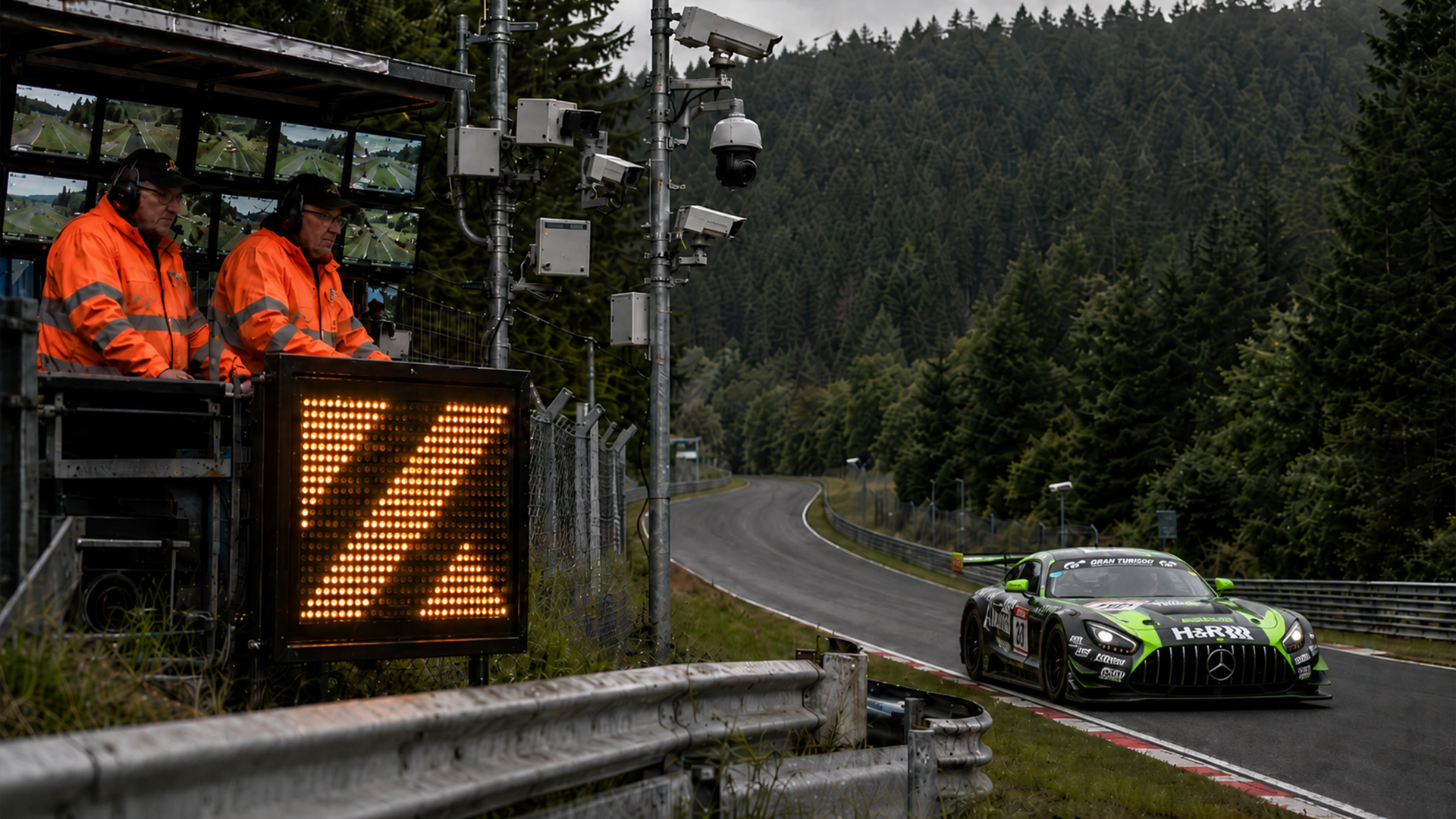
At this year’s ADAC RAVENOL 24h Nürburgring, that balance shifts again. For the first time, the Nordschleife’s full digital safety system will be integrated into race operations at the 24-hour event. The system includes 100 cameras and 46 LED panels installed around the circuit, supported by 80 kilometers of electrical and data cables.
It is a major step for a race where visibility, reaction time, traffic, weather, and darkness can decide whether a small problem stays small.
A Two-Year Project Built Around Safety
The digital upgrade was completed after a two-year construction phase and an investment of around 12 million euros. Its purpose is straightforward: give the Nürburgring a better way to monitor the entire Nordschleife and warn drivers more quickly when something goes wrong.
That is not easy on this circuit. The Nordschleife is not a compact modern track where race control can oversee most of the action through a limited number of camera angles. It runs through forests, elevation changes, blind crests, high-speed bends, and remote sections where incidents can develop quickly.
The new digital infrastructure allows the full Nordschleife, including all 73 turns, to be monitored more continuously than before.
For normal operations such as tourist drives, track days, and test sessions, that has already been valuable because not every marshal post is staffed during those activities. Cameras and LED panels make it easier to track vehicles and warn drivers when hazards appear.
Now the same system is being added to the race environment.
Why the 24-Hour Race Needs Faster Information
The Nürburgring 24 Hours is one of the most demanding races in the world because it combines speed with constant traffic management. GT3 cars share the track with slower classes. Professional drivers share space with amateurs. Conditions can change from dry to damp within a single lap. Night running makes visibility harder. A stopped car, fluid spill, puncture, accident, or damaged vehicle can become a serious risk if following drivers do not get warning quickly enough.
That is where the digital system matters. Race control can now receive more immediate visual information from more areas of the track. If a car stops, if debris is visible, if oil or coolant creates a slippery section, or if an incident blocks part of the road, officials should have a better chance of reacting quickly.
The system does not remove the danger of the Nordschleife. Nothing can. But it shortens the information gap between an incident happening and the rest of the field being warned.
LED Panels Will Support the Marshals
The 46 LED panels are not replacing the human marshal system during the race. Their role is more specific. During daylight conditions at the 24 Hours, the panels will assist drivers and marshals by displaying the same flag signal being shown by the relevant marshal post. The panels are intended to improve visibility and reinforce the warning, especially where a physical flag may be harder to spot at speed.
That distinction matters because the panels themselves do not carry independent motorsport regulatory authority in this setup. The official signal remains the marshal’s flag. The LED panel supports the message rather than replacing it.
As darkness falls, light signals will take over in the way the event has used them before. The difference is that the digital network now adds a broader layer of support across the circuit.
The System Has Already Proven Useful Outside Racing
The Nürburgring’s management has already used the digital system during tourist drives, test operations, and other track activity. That background is important because the 24-hour race is not the system’s first live test. The infrastructure has already helped improve monitoring and traffic flow in less formal track operations, where mixed driver experience and variable speeds can make fast warnings especially important.
Ingo Böder, Managing Director of Nürburgring GmbH, said the digitalization step has helped improve tourist and test drives for nearly two years, and that the 24 Hours can now benefit from it as well. That makes this race integration feel less experimental and more like the next logical stage.
Cockpit Cameras Add Another Layer
The digital Nordschleife system is not the only safety tool being used at the event. The 24 Hours also uses an Incident Camera System, which enables live transmission from cockpits. Combined with trackside cameras and LED warning panels, that gives officials more information from both outside and inside the cars.
That matters because trackside cameras can show where a car is and what is happening around it, while cockpit feeds can help show what the driver sees. Together, those systems can improve understanding of incidents, especially in confused situations involving traffic, poor visibility, or multiple cars.
For a race as large as the Nürburgring 24 Hours, no single system is enough. The value comes from layers.
Technology Cannot Change What the Nordschleife Is
The digital upgrade does not make the Nordschleife a normal modern circuit. That is the point. The Nürburgring 24 Hours uses a long layout combining the Nordschleife and Grand Prix circuit, creating a lap of more than 25 kilometers. Red Bull’s event guide describes the race as using a 25.378-kilometer layout, while BMW notes that one lap stretches to roughly 25.4 kilometers when the Nordschleife and much of the Grand Prix circuit are combined.
That scale is what makes the race special, but also what makes it difficult to manage. Drivers can be minutes apart from the pit lane, weather can vary by section, and incidents may happen far from the most visible areas.
Digital monitoring helps bridge that distance. It does not sanitize the race. It helps the people running it understand the race more quickly.
A Modern Safety Net for an Old-School Race
The Nürburgring 24 Hours has never been a race that rewards only raw speed. It rewards judgment, patience, traffic awareness, mechanical sympathy, and the ability to survive a circuit that changes constantly over a full day and night. Better safety systems do not alter that challenge. They make the challenge more manageable.
The full use of the digital Nordschleife network is therefore not just a technical upgrade. It is a sign of how endurance racing is evolving. The race can remain enormous, difficult, and atmospheric while still adopting better tools for oversight and reaction. It can keep the soul of the Green Hell while improving the way hazards are detected and communicated.
That balance is what makes this step important. The Nordschleife is still the Nordschleife. It is still long, fast, unforgiving, and unpredictable. But for the first time at the 24-hour race, race control will have a digital safety network watching every corner more closely.
At a circuit where seconds matter, that could make all the difference.
