Scientists Stunned by Out-of-Order Planetary System
A Baffling Planetary System Challenges Scientific Understanding
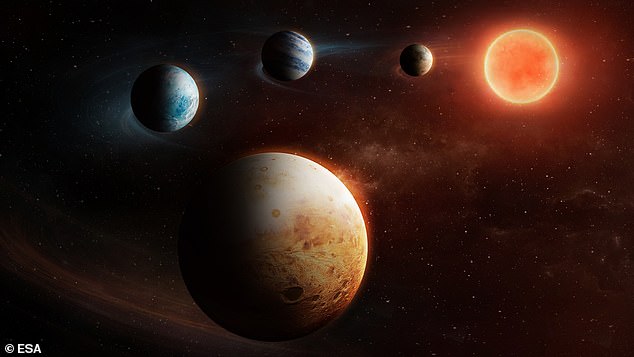
A recent discovery has left scientists puzzled as they observed a planetary system that defies the usual rules of planet formation. This strange system, located around a cool and faint red dwarf star named LHS 1903, appears to be "inside out." The system includes four planets, but their arrangement is anything but conventional.
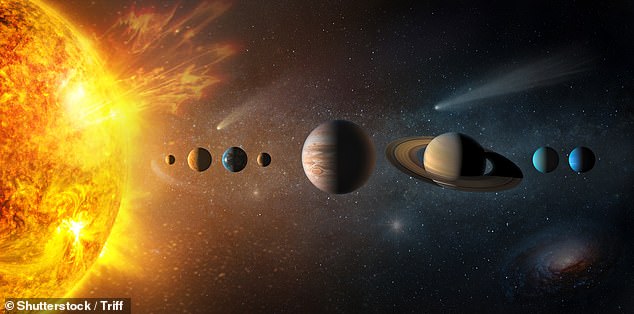
In typical planetary systems, the planets closest to the star are rocky, while those further away tend to be gaseous. For instance, in our own Solar System, Mercury and Mars are rocky, whereas Jupiter and Neptune are gaseous. However, the newly discovered system breaks this pattern. It starts with a rocky planet, followed by two gas giants, and ends with another rocky planet on the outer edge.
"This strange disorder makes it a unique inside-out system," said Dr. Thomas Wilson, the lead author of the study. He added, "Rocky planets don't usually form far away from their home star, on the outside of the gaseous worlds."
How Planets Form and Why This System Is Different
Normally, the planets closest to a star are rocky because solar radiation sweeps away their gaseous atmospheres, leaving behind dense, solid cores. In contrast, planets located farther from the star can retain their gaseous atmospheres.
The team of researchers from the University of Warwick used the European Space Agency's Cheops satellite to study the LHS 1903 system. They found a rocky planet on the fringes of the system, which initially led them to consider theories such as the planets swapping places or the outer rocky planet losing its atmosphere in a collision. However, these hypotheses were soon ruled out.
Instead, the team found evidence suggesting that the planets did not form simultaneously. Rather, they formed one after another, starting from the innermost planet and moving outward.
"By the time this final outer planet formed, the system may have already run out of gas, which is considered vital for planet formation," explained Dr. Wilson. "Yet here is a small, rocky world, defying expectations."
A New Insight into Planet Formation
"It seems that we have found first evidence for a planet that formed in a gas-depleted environment," he continued. This discovery challenges existing models of how planets form and evolve, suggesting that there may be more diversity in planetary systems than previously thought.
What remains unclear is whether this inside-out system is an anomaly or if similar systems exist elsewhere in the universe. Scientists are now eager to explore this possibility further.
The Importance of the Discovery
Maximilian Günther, a Cheops project scientist at ESA, emphasized the significance of the findings. "Much about how planets form and evolve is still a mystery," he said. "Finding clues like this one for solving this puzzle is precisely what CHEOPS set out to do."
This discovery highlights the importance of continued exploration and observation of exoplanetary systems. As technology advances, so does our ability to uncover new and unexpected phenomena in the cosmos.
The LHS 1903 system serves as a reminder that the universe is full of surprises, and our understanding of planetary formation is still evolving. With each new discovery, scientists get closer to unraveling the mysteries of how planets come to be and what conditions allow for the formation of diverse worlds.
