South Koreans Worry AI Could Replace Their Jobs as Dependence Grows
“My colleagues and I often joke, ‘At this rate, AI will take all our jobs by the time we become managers,’ and it sends chills down our spines,” said Kim Yushin, 26, a second-year employee in charge of overseas sales at a domestic conglomerate-affiliated trading company. Kim now relies on AI chatbots for most of his tasks, from drafting emails and generating Excel formulas to analyzing clients, conducting market research, and more. AI, which significantly boosts his work speed and efficiency, has become indispensable. Yet, a lingering anxiety—“Is this really okay?”—persists. The more he uses AI, the more he feels his logical reasoning and professional capabilities gradually deteriorating. “Since AI is involved in almost every step of my work, it feels like the focus has shifted from humans to AI,” he said.
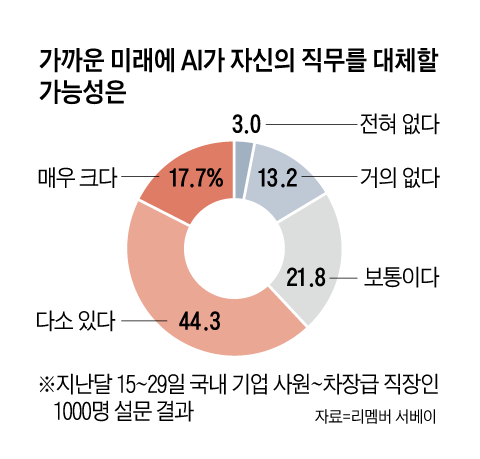
The growing reliance on artificial intelligence in the workplace has sparked significant concerns among employees. A recent survey conducted by a global HR and payroll platform found that a majority of South Korean office workers are worried about the potential of AI replacing their jobs. According to the findings, 62% of the 1,000 participants believed that AI could replace their roles in the near future. As the use of AI becomes more prevalent, these fears have intensified, leading to a sense of uncertainty among workers.
The Fear of Over-Reliance on AI
Workers are increasingly aware of the risks associated with over-reliance on AI. The survey revealed that 80.6% of respondents had felt concerns about “excessive AI dependence,” with 44.5% stating they “often feel this way.” The primary reasons cited were “decline in work capabilities” (28.1%), “deterioration in writing skills” (24.5%), and “reduced information-searching abilities” (20.3%). This indicates a growing awareness of the potential negative impacts of AI on human skills and critical thinking.
There are even instances where work has come to a standstill when AI is unavailable. Kim Da-in, 27, an office worker, has witnessed experienced colleagues panic when the AI chatbot they rely on reaches its daily usage limit. “When the cap is exceeded and the chatbot becomes inaccessible, even experienced seniors are at a loss,” she said. “We’ve even failed to deliver results to clients on time.”
Impact on Cognitive Abilities
Research from institutions such as the Massachusetts Institute of Technology (MIT) Media Lab has highlighted the potential cognitive effects of prolonged AI use. Their findings suggest that extended use of generative AI could impair critical thinking and brain activity. Similarly, Microsoft and Carnegie Mellon University researchers reported that AI can slow human cognition. The study noted, “The higher the trust in generative AI, the greater the decline in critical thinking, which could lead to reduced independent problem-solving abilities.”
Widespread Use of AI in Daily Work
AI chatbots are deeply embedded in daily work life. According to the survey, workers primarily use AI for “information search and research” (24.6%), “document writing and editing” (24.5%), “task management and productivity” (14.2%), and “technical tasks like coding” (11.2%). Many reported significant efficiency gains. When asked how much time they saved post-AI adoption, 48.6% said “10–30%,” while 11.6% claimed “over 50%.”
Lee Mo, 28, an employee at a large corporation, said, “Work feels awkward without AI now. Stories from seniors about working without AI feel like a different world.” The survey found that 98.2% of workers use AI, with 27.8% calling it a “core tool.” Over 70% subscribe to at least one paid chatbot, and 36% use two or more.
Concerns About Job Replacement
Despite the benefits, many workers fear their roles could soon be replaced. The primary reasons cited were “AI’s rapid development speed” (45.3%) and “AI’s accuracy and processing speed” (29.2%). Notably, 13.4% mentioned “management’s active pursuit of workforce reduction.”