Time to ditch old-school software firms?
The SaaSpocalypse: A Threat or a Momentary Hype?
Investors are now questioning whether the so-called 'SaaSpocalypse' is a real threat or just an overblown alarm. This concern has been triggered by the sudden loss of $1 trillion in market value for various SaaS (software-as-a-service) companies within a single day earlier this month. The decline has raised fears that the rise of artificial intelligence (AI) could significantly impact not only software firms but also those in the information services sector.
Jensen Huang, the CEO of chip giant Nvidia, finds this scenario "the most illogical thing in the world." However, the downturn in stock prices has continued, with recent victims including Dassault Systemes, a French software company. Dassault's shares dropped by 21% on Wednesday, despite assurances from its CEO, Pascal Daloz, that the company would lead the industrial AI transformation. This decline followed similar drops in shares of UK-based price-comparison websites such as Mony and Future, which owns GoCompare.
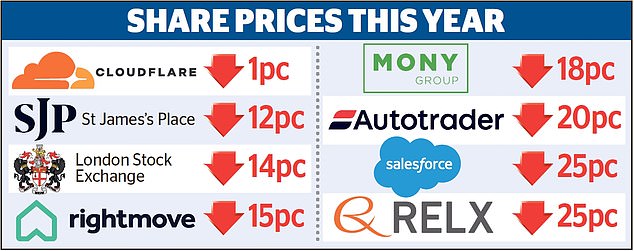
The growing concern is that these companies may be negatively affected by the emergence of Insurify, a US platform that uses the ChatGPT AI system from OpenAI to find better car insurance deals. Insurify’s CEO, Snejina Zacharia, stated that the company is redefining the insurance shopping experience by making it feel as simple as having a conversation.
Shares in US and UK wealth managers like Charles Schwab and St James's Place have also suffered. The worry is that clients might prefer cheaper alternatives, such as Altruist, a US start-up that uses AI to create financial-planning strategies.
The initial panic around the SaaSpocalypse was sparked by the decline in major software companies like Sage. Relx, which operates in legal analytics, and the London Stock Exchange Group, which has a significant data division, were also hit. US corporations such as AppLovin, LegalZoom, Oracle, and Salesforce were caught in the turmoil.

The AI Threat
The root of these declines lies in the announcement of new updates to Claude, an AI system developed by the San Francisco-based start-up Anthropic. Described as "a more cerebral version of ChatGPT," Claude has raised concerns among investors.
Michael Brown, an analyst at UBS, summarized the uncertainty: "We're in this moment where we don't really know what the next 12 or 24 months will bring."
While some may dismiss the volatility as temporary, the potential impact of AI on the software industry remains a critical issue. Jensen Huang believes that AI systems will enhance rather than replace software products. He posed a rhetorical question: "Would you use a screwdriver or invent a new screwdriver?"
It may be too early to determine who will emerge as winners or losers in this AI-driven shift. However, it is essential for investors to monitor how these developments affect their portfolios.
The AI Opportunity
For those who invested in the Magnificent Seven US tech stocks—Alphabet, Amazon, Apple, Meta, Microsoft, Nvidia, and Tesla—the focus on AI has largely been beneficial. The SaaSpocalypse serves as a reminder that AI can have both positive and negative implications for portfolios.
Jason Hollands of Bestinvest noted that a year ago, it was believed that software and information service companies would benefit from AI's growth. He emphasized that "AI is both an opportunity and a threat to portfolios—not a one-way bet."
Despite the price drops, some software stocks may now be considered bargains. Analysts suggest that companies like Relx and the London Stock Exchange could be "buys." Erik Engstrom, CEO of Relx, assured shareholders that it is "almost inconceivable" that AI could replicate its current offerings, which are already enhanced by AI.
The London Stock Exchange's shares are currently at 7,570p, but Barclays has set a target price of 12,000p following news that US activist investor Elliott has taken a stake in the company. Sage is rated a "hold," but investing in these stocks now is only advisable for adventurous investors, as it may still be too early to identify the winners and losers.
The Rivalry and the Future
The competition from AI is expected to lower the fees that software companies can charge, potentially reducing their profits. However, as Wedbush Securities points out, companies that have invested billions in software infrastructure may be reluctant to cut ties with existing providers due to data security concerns.
If you hold the Finsbury Growth & Income trust, you are particularly exposed to software and information-service companies. The trust's portfolio includes Auto Trader, Experian, the London Stock Exchange, Rightmove, and Sage. However, Nick Train, the trust's manager, believes that these established companies will adapt by offering AI-enhanced services to their clients.
Some software companies are already taking steps to integrate AI into their offerings. Cloudflare, a US-based company, has developed AI Crawl Control, which helps media companies manage how AI systems scrape their website content. Analysts have set a $300 target for Cloudflare shares, which are currently trading at around $190.
The AI Market Potential
OpenAI, led by Sam Altman, is preparing for a stock market debut this year with a potential valuation of $830 billion. This comes after the popularity of ChatGPT, which has 800 million users. Similarly, Anthropic, led by ex-OpenAI executive Dario Amodei, is also poised to go public with a likely valuation of $350 billion.
For investors, the Scottish Mortgage Investment Trust made a strategic move by acquiring a stake in Anthropic late last year. This appears to be a wise decision, given the acclaim surrounding Claude, whose tools allow customers to produce and use software without extensive technical skills. Recent updates include a legal service that enables contracts to be drafted and reviewed quickly.
Another set of updates automates tasks in advertising, marketing, and sales departments. As a result, Anthropic is now considered one of the four most valuable private companies globally, with revenues expected to reach $9 billion in 2025 and $30 billion in 2026.
Altman and Amodei may be rivals, but they share concerns about the consequences of the AI boom. In a 19,000-word essay published last month, Amodei warned that humanity is about to gain almost unimaginable power, and it is unclear if our systems are mature enough to handle it.
This essay serves as a wake-up call, reminding investors to monitor the impact of AI on their portfolios. The SaaSpocalypse may just be the beginning of a larger transformation.
