Companies Rehire Workers After AI Layoff Mistakes
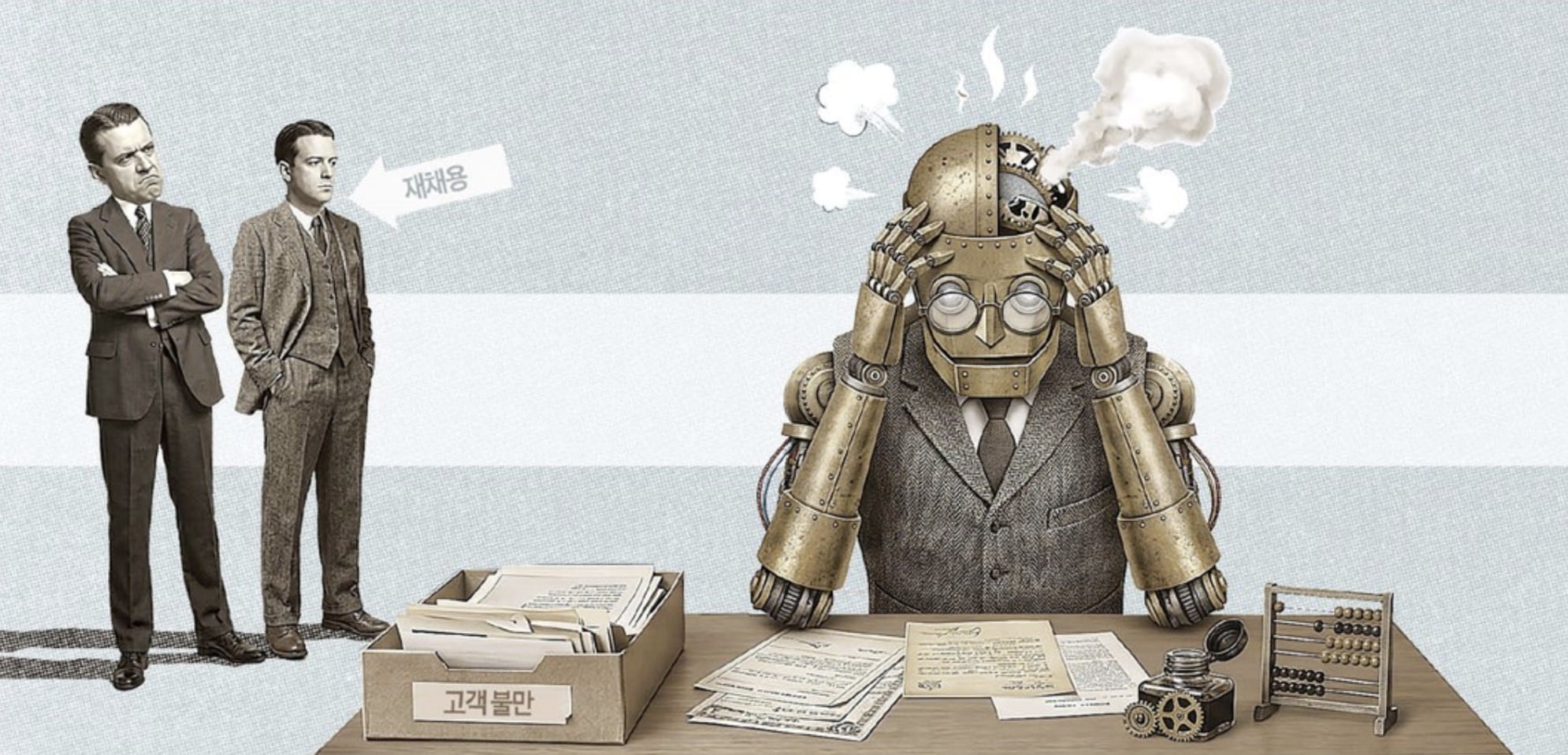
Artificial intelligence (AI) has been introduced too quickly in many organizations, often with the goal of reducing labor costs. This was highlighted by Sebastian Siemiatkowski, CEO of Klarna, a Swedish fintech company, during a Reuters interview last year. Klarna reduced its workforce from 5,500 to 3,400 employees, saving $10 million, under the belief that AI could replace human tasks. However, this move led to a significant drop in customer satisfaction and an increase in complaints. Eventually, the company began rehiring some of the employees it had laid off starting in the second half of the previous year.
Klarna was not alone in this approach. A survey conducted by CareerMinez, a U.S. HR consulting firm, revealed that 68.3% of companies that underwent workforce restructuring due to AI had already rehired some of their laid-off employees. Notably, 35.6% of these companies had rehired more than half of the workers they had previously let go.
In recent years, global companies have invested heavily in AI while simultaneously reducing their workforces, driven by the rapid development of generative AI. However, many of these companies have since shifted their strategies and begun rehiring employees they had previously laid off. The question remains: why?
AI Falling Short of Expectations
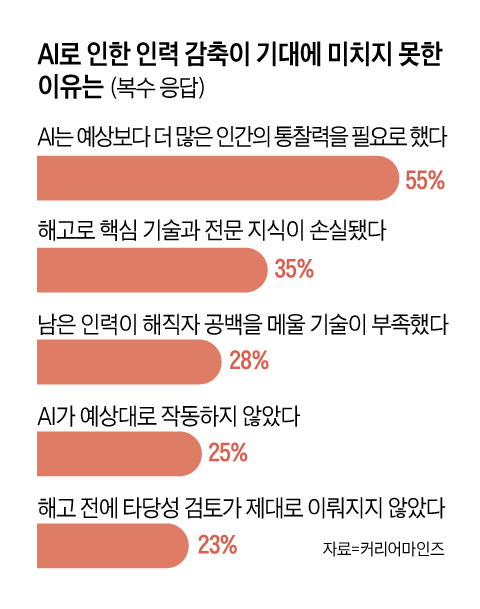
The primary reason for this shift is that AI has not met expectations. In the CareerMinez survey, 55% of respondents indicated that "AI required more human insight than anticipated." This was followed by "core skills and expertise were lost due to layoffs" (35%) and "remaining employees lacked the skills to fill the gaps left by laid-off workers" (28%). These responses highlight that AI has struggled to adequately replace human workers, and that human expertise remains crucial.
McDonald’s tested an AI ordering system at 100 U.S. drive-thru locations but eventually withdrew the system after acknowledging its failure. Online videos showed incidents such as an AI machine adding excessive butter to a caramel ice cream order or adding hundreds of dollars’ worth of chicken nuggets to an order contrary to customer requests. Similarly, Prosus, a Dutch tech investment firm, developed an AI agent to perform tasks similar to its data analysts but failed to launch it fully due to minor errors causing customer dissatisfaction.
In consumer-facing service sectors, companies are rehiring humans due to customer resistance to AI. Verizon, a U.S. telecommunications giant, planned to replace call center staff with AI but announced plans to increase human customer service representatives this year. A Verizon source stated, “40% of consumers still prefer direct conversations with humans and express dissatisfaction when unable to connect with a representative.”
Companies' cost-cutting measures through AI have paradoxically led to higher expenses. Forrester Research analyzed that companies ended up paying 1.27 times the cost of layoffs due to knowledge gaps and reduced productivity while trying to save money with AI, prompting them to rehire workers.
Rushing to Replace, Then Regret
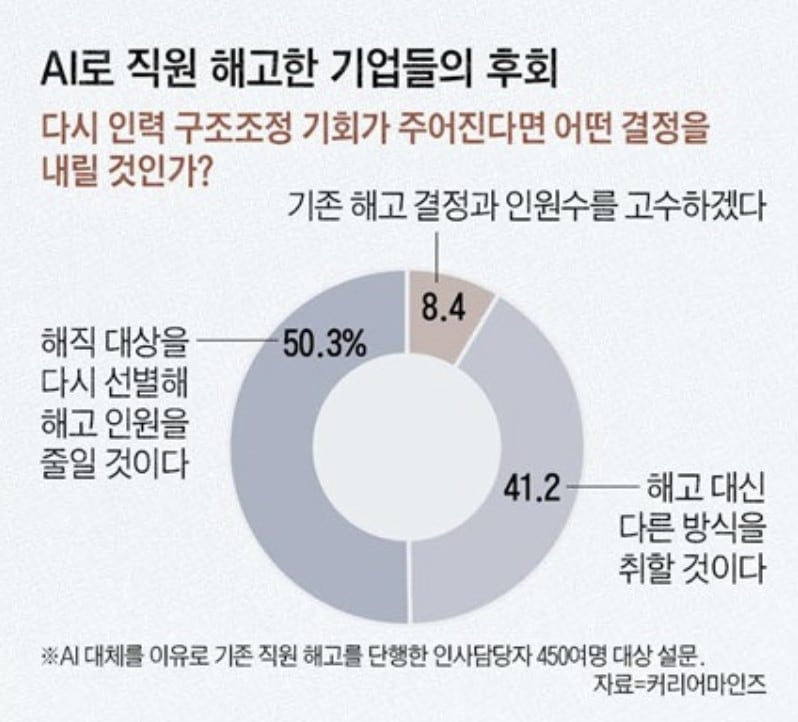
As a result, companies are regretting their hasty decisions. In the CareerMinez survey, when asked, “What decision would you make if given another chance to restructure the workforce?” only 8.4% responded, “We would stick to our original decision.” 41.2% answered, “We would take alternative measures instead of layoffs,” and 50.3% said, “We would re-evaluate the targets and reduce the number of layoffs.”
A survey by OrgView, an organizational design platform, revealed that 55% of executives who reduced workforces to replace them with AI admitted their layoff decisions were wrong. OrgView analyzed, “Companies that rushed to cut workforces without fully understanding AI technology, expecting cost savings, eventually had to rehire laid-off employees.” 32% of companies that conducted layoffs faced situations requiring rehiring.
With a significant gap between expectations and reality regarding AI efficiency, the trend of “layoffs followed by rehiring” is expected to continue. Gartner predicted that by 2027, 50% of companies that reduced workforces due to AI will rehire employees. Kathy Ross, a Gartner senior analyst, said, “While AI-driven layoffs have garnered attention, the reality is far more complex. As companies confront AI’s limitations and rising customer expectations, reinvesting in talent will be necessary to maintain service quality and growth.”
Increasing New Hires
Beyond rehiring laid-off workers, some companies are expanding overall hiring, including new graduates. IBM announced in March that it would triple its new graduate hiring in the U.S. this year. Recruitment spans all business units, including software, consulting, infrastructure, and marketing, with roles ranging from developers to quantum data scientists and social media/influencer marketers.
Nickle LaMoreaux, IBM’s Chief Human Resources Officer (CHRO), said, “If we do not sustain investment in new hires, the talent supply chain will collapse and the talent pool will deplete in 3–5 years. Companies must redefine roles for the AI era.” Even if AI reduces repetitive tasks, a lack of human development will leave mid-level and leadership positions vacant.
A survey of 350 global CEOs by Teneo found that 67% are increasing hiring across all levels this year due to AI adoption. CEOs cited “strengthening workforces with AI and automation” (50%) and “upskilling talent” (46%) as top talent management priorities. Teneo analyzed, “These companies are not merely increasing headcount but focusing on nurturing agile and creative talent suited for the AI era.”
However, this does not mean the hiring market will continue to expand as it did in the past. Companies are rehiring not because they abandoned AI but to reinforce areas AI cannot fully replace and address transitional needs. Experts argue that the recent hiring surge is merely a transitional phenomenon due to AI’s incompleteness. The IMF (International Monetary Fund) projected, “Approximately 40% of global employment and 60% of advanced economies’ jobs will be affected by AI in the future.”
월 5900원 멤버십, 신문 독자에게는 2900원, 조선멤버십
55000원 상당의 신문-잡지 8종 마음껏 보기, 조선멤버십
현금처럼 쓸 7000포인트 받아 알뜰한 쇼핑, 조선멤버십
