Hidden electron-nucleus interactions reveal dark matter clues
New Insights into Dark Matter and Particle Interactions
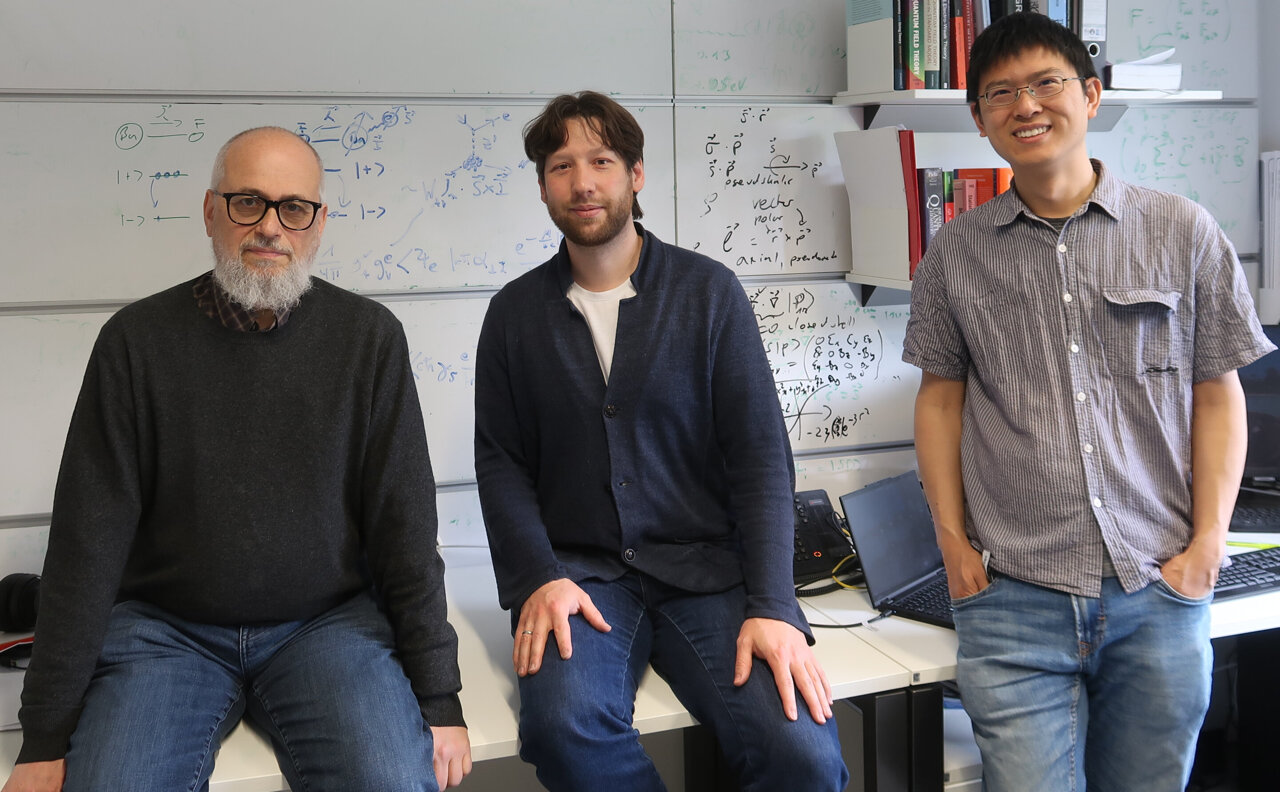
A groundbreaking study conducted by Dr. Konstantin Gaul, Dr. Lei Cong, and Professor Dr. Dmitry Budker from Johannes Gutenberg University Mainz (JGU), Helmholtz Institute Mainz (HIM), and the PRISMA++ Cluster of Excellence has revealed new possibilities for understanding dark matter. Their research, published in Physical Review Letters, presents constraints on previously unexplored candidates for dark matter and other hypothetical particles that extend beyond the Standard Model of particle physics.
The team focused on interactions mediated by Z' bosons, which are theoretical particles that could serve as mediators of the weak interaction and potential dark matter components in various extensions of the Standard Model. By analyzing precision measurements of barium monofluoride (BaF) molecules, they were able to set the first constraints on these interactions. This research addresses a significant gap in physics: a regime of forces between electrons and nuclei that had not been explored through laboratory experiments or cosmological data.
Understanding the Composition of the Universe
Our universe is composed of about 4% visible matter, which includes planets, stars, and life on Earth. The remaining 96% is made up of dark matter and dark energy, with dark matter accounting for approximately 23%. While astrophysical observations confirm the presence of dark matter throughout the cosmos, its exact composition remains unknown. Numerous theories and ongoing experiments are working to uncover the nature of these elusive particles.
An Interdisciplinary Approach to Particle Physics
To investigate the role of Z' bosons in electron-nucleus interactions, the researchers used the supercomputer MOGON 2 at JGU to reinterpret existing precision measurement results from BaF molecules. This study required a deep understanding of the weak interaction and the properties of beyond-SM bosons, along with expertise in atomic, molecular, and nuclear physics. This interdisciplinary approach highlights the collaboration between theorists and experimentalists, leading to significant scientific breakthroughs.
Dr. Gaul and Dr. Cong are part of a new generation of theorists working at the intersection of atomic, molecular, and optical physics, as well as particle and nuclear physics. Their integration into an experimental group within HIM and PRISMA++ has fostered productive collaborations and contributed to important findings, such as this recent study.
Exploring New Frontiers in Physics
In the search for "new physics," this approach offers valuable insights into long-standing questions. As Dr. Gaul explained, polar molecules provide a unique environment for detecting subtle physical effects that might otherwise remain invisible. This makes them powerful laboratories for exploring new forces in the universe.
The study also analyzed similar bounds using cesium-133 atoms, a more traditional method for studying electron-nucleus interactions. However, unlike atomic studies, the analysis of diatomic molecules like BaF does not rely on nuclear theory. This independence from nuclear physics uncertainties allows for more precise results.
Future Implications and Research Directions
The current study demonstrates that molecular physics is becoming a vital tool for exploring new physics, rivaling traditional atomic methods. According to Dr. Gaul, future experiments with heavy diatomic species like BaF could increase sensitivity by 100-fold, enabling deeper exploration of the hidden forces of the universe.
This research opens new avenues for understanding dark matter and the fundamental interactions that shape our universe. It underscores the importance of interdisciplinary collaboration and innovative methodologies in advancing our knowledge of particle physics.
Key Findings and Contributions
- First Constraints on Z' Boson Interactions: The study provides the first constraints on interactions mediated by Z' bosons using BaF molecule measurements.
- Interdisciplinary Collaboration: The project combines expertise from multiple fields, including atomic, molecular, and nuclear physics.
- Precision and Accuracy: Molecular physics offers a more accurate method for studying interactions compared to traditional atomic approaches.
- Future Potential: Heavy diatomic molecules like BaF could significantly enhance sensitivity in future experiments, leading to new discoveries.
This work represents a critical step forward in the quest to understand the nature of dark matter and the fundamental forces that govern the universe.
