The rise, fall, and possible revival of the Rolex 'Pepsi' GMT-Master II
The Legacy of the Rolex GMT-Master II "Pepsi"
On 14 April, Rolex announced its new watches for the year. At the same time, it updated the list of models it would no longer produce. Among those removed from the catalogue were the Day-Date 36 with the turquoise dial, the Datejust 41 with the “Azzurro blue” dial, and the white gold Submariner Date nicknamed the “Cookie Monster”. Their retirement largely passed without comment. That of another watch, the GMT-Master II with the red-and-blue bezel – nicknamed the “Pepsi” – did not.
Rolex’s Pepsi has existed, in one form or another, since the mid-1950s. It remains one of the most recognisable watches in modern horology – ask someone to picture a Rolex, and chances are the Pepsi is what they’ll think of.
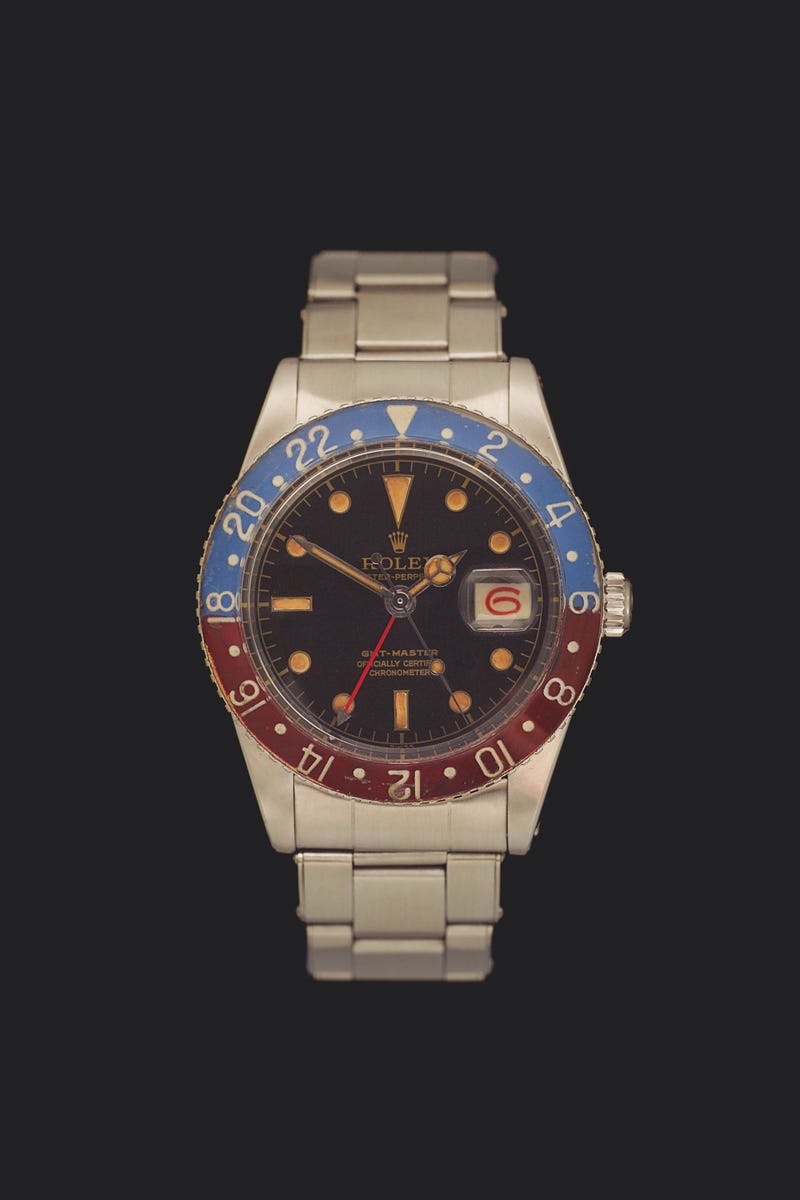
A Tool for Pilots, A Symbol of Cool
Originally developed in partnership with Pan American World Airways, the watch was designed for long-haul pilots who needed to track Greenwich Mean Time alongside local time. It did this with a rotating 24-hour bezel and an additional hand that circled the dial once per day, allowing two time zones to be read at a glance.
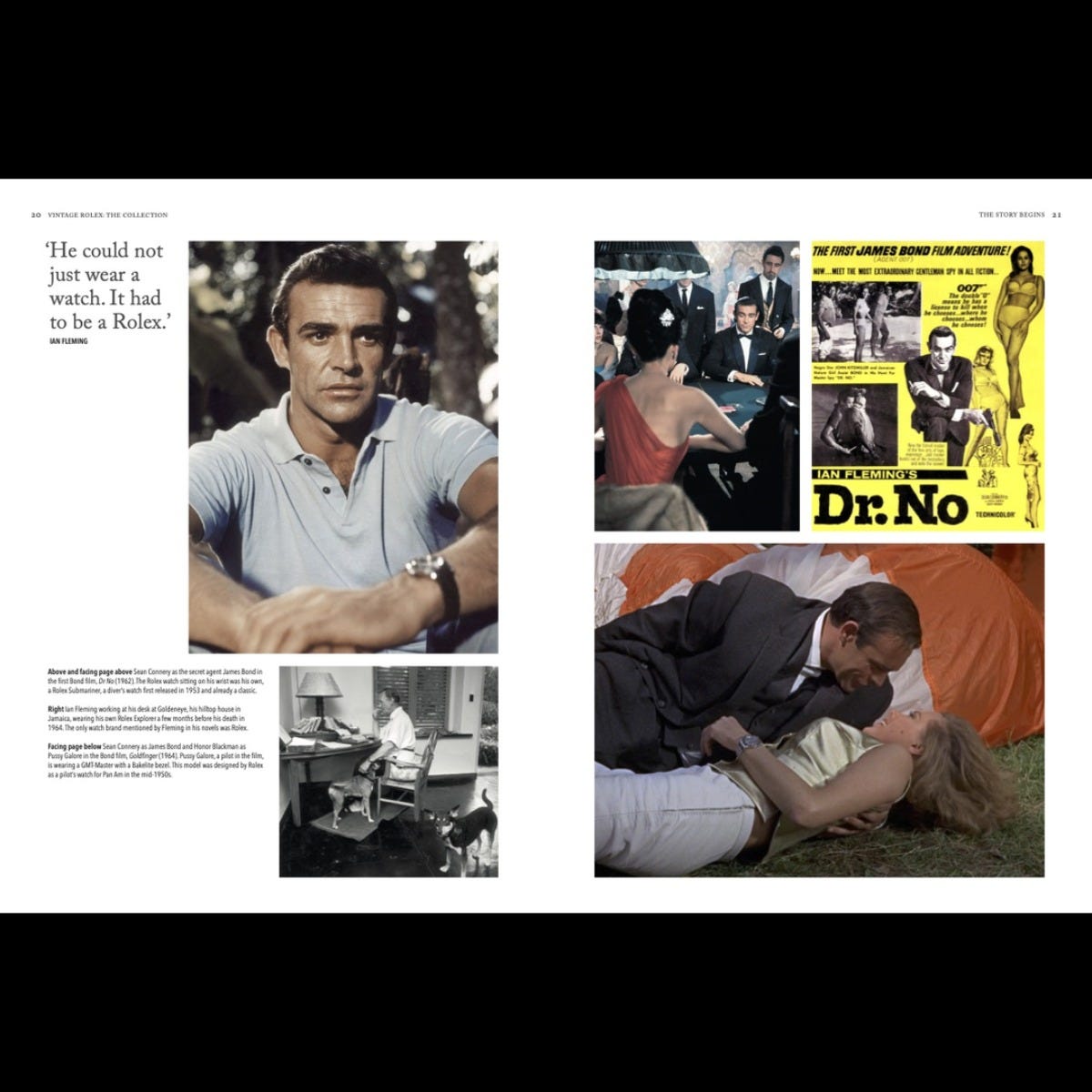
It was a practical tool first, but it did not stay that way for long. The Pepsi was soon connected to James Bond, Clint Eastwood and Marlon Brando, its eye-catching design becoming shorthand for adventure, glamour and a certain stripe of 20th-century cool.
Readers of a particular vintage might recall it on the wrist of Tom Selleck, aka TV’s Magnum, PI, who summed up its appeal in the most 1980s way possible.
“My Rolex GMT-Master has been underwater, buried in sand, taken I don’t know how many knocks, and never a problem… Personally, I thought the red went well with the Ferrari and the blue matched Hawaii’s lagoons and sky.”
Evolution of the Pepsi
The original GMT-Master ref. 6542, launched in 1954/5 used the two-tone bezel to distinguish night (blue) from day (red) across a second time zone. Early versions were made from a transparent plastic often referred to as Bakelite, and used radium on the dial, making them both fragile and, by modern standards, slightly radioactive.
The design carried into the ref. 1675, produced from 1959 to 1980, which swapped in aluminium and added crown guards. By the time the GMT-Master II arrived in 1989, introducing an independently adjustable local hour hand, the watch had become embedded in popular culture.
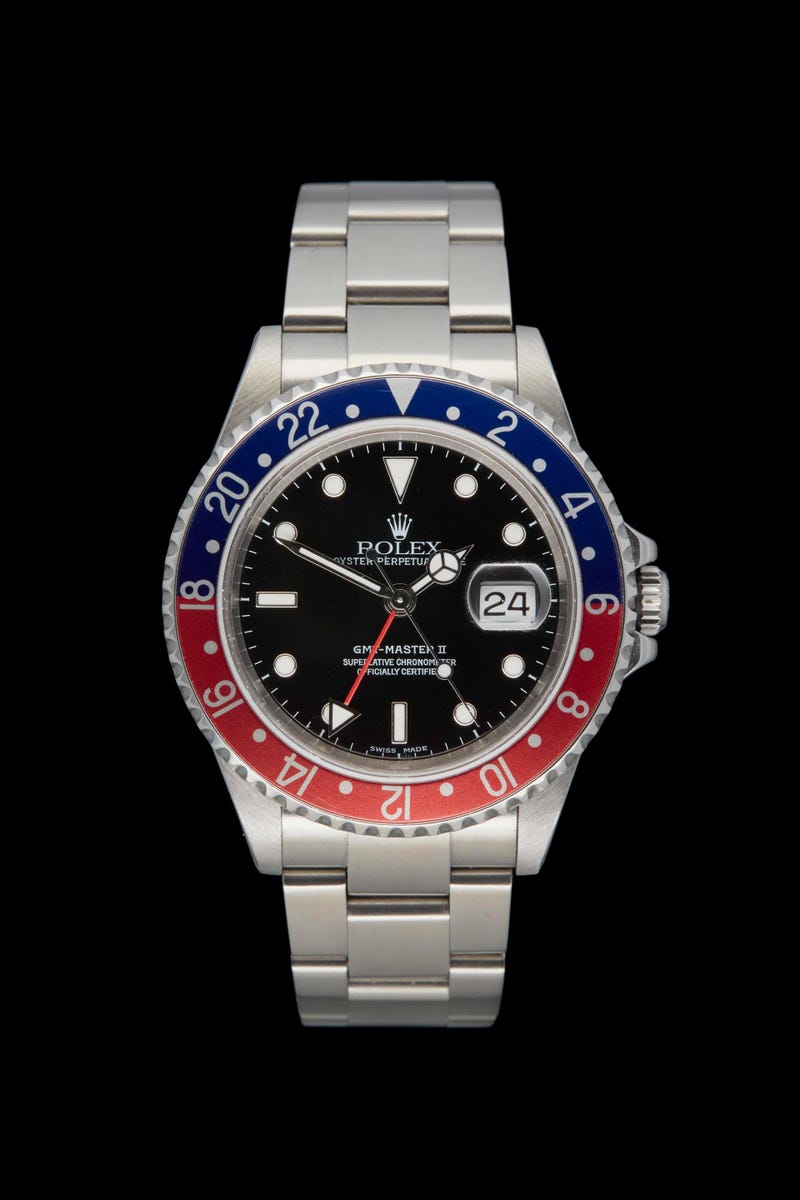
In 2007, Rolex moved the GMT-Master II to ceramic bezels but could not initially produce the red-and-blue split cleanly, since the colours tended to bleed together during firing. The Pepsi disappeared as aluminium inserts were phased out. It returned in 2014 after Rolex developed a multi-stage process to stabilise the two colours in a single ceramic insert, first in white gold and then in steel in 2018 – the version most people now know, and one of the most in-demand watches of the past decade.
The Market Reaction to Discontinuation
The steel Pepsi was never easy to buy. Whether because of demand, production limits or Rolex’s usual control of supply, it quickly became a watch most customers could only realistically find on the secondary market. Earlier this year its RRP was £9,850, with pre-owned prices typically 2.5 times that.
The latest discontinuation was not a complete surprise. Rumours that the Pepsi was on its way out had surfaced around several previous Rolex updates. The brand has a habit of retiring references, sometimes for good and sometimes only to bring them back a few years later.
This time, the market did not wait for a long goodbye. Prices jumped almost immediately, with one US dealer emailing me within days quoting prices pushing $40,000.
For David Silver, who runs The Vintage Watch Company in London's Burlington Arcade alongside his father, the news is both good for business and an intriguing historical development. The shop describes itself as home to “the largest vintage Rolex collection in the world” (check out David's excellent book here).
The History Behind the Pepsi
The GMT was part of Rolex’s 1950s push into tool watches, alongside the Submariner, Explorer and Milgauss – a period that set the template for the brand as we know it today.
David Silver: The important thing to stress is that this wasn’t originally Rolex’s idea. Or at least, not entirely. The story is that Pan Am approached Rolex to develop a prototype watch for transatlantic pilots, something that could display two time zones simultaneously. The folklore is that it was such a successful design that Rolex then put it into production in 1955.
It’s the closest Rolex comes to a watch being shaped by an external brief. Or at least the clearest example of it.
That’s right. Discussions with Pan Am go back to 1954.
It’s possible Rolex was already working on something similar?
Possibly. The first reference is the 6542, known for its Bakelite bezel. The colours were functional: blue for night hours, red for daytime. The first generation used Bakelite with highly radioactive material painted inside the bezel, as well as on the hands and the luminous plots on the dial. So you’ve got quite a lively watch if you put it near a Geiger counter.
Cultural Impact and Popularity
Was the level of luminosity upped for the GMT?
Not really. Early Submariners and Oysters also used similar amounts. The key thing here is how it functioned in the cockpit at night. The bezel was designed with that in mind.
The high-contrast red and blue colours were functional, but they also had instant pop culture appeal. The colours of the American flag, superhero uniforms, NASA, as well as Pepsi.
That's right. Although we don’t know when the first mention of Pepsi comes in.
Then came the James Bond connection.
The famous appearance is Goldfinger, and not on Bond. Honor Blackman, who played Pussy Galore, is a pilot in the film and wears a GMT-Master. The story is that it may have been [producer] Cubby Broccoli’s own watch. That’s the first time it appears in a film. It’s a pilot’s watch, traditionally a man’s watch, so there’s also a feminist reading there. A female pilot wearing it, along with her team. People have spoken about that moment quite a bit.
We’ll never know for certain if it was Cubby Broccoli’s watch, but it makes sense – a pilot wearing a pilot’s watch.
Exactly. And this is before sponsorship deals. There’s nothing forced about it. Although Sean Connery’s Submariner was definitely Broccoli’s [in the first Bond film, 1962’s Dr No, Connery wore the producer’s watch on screen]. Rolex features because Ian Fleming wrote about it in the books. He wore an Explorer himself.
The Future of the Pepsi
Did the Bond connection drive sales?
The watch had already been discontinued by the time those films appeared.
Dr No is 1962, Goldfinger is 1964. So the GMT would already have been a slightly older model by then, which is why it may well have been Broccoli’s own watch. By 1964, you’re no longer seeing Bakelite GMTs. You’ve already moved on to the next generation, with crown guard protection.
And that’s the version that really cements itself in popular culture.
Yes, because the bezel was changed to aluminium. It’s generally thought the Bakelite bezels were cracking. Also, I think Rolex started recalling them, because by that point the issues around [radioactive] luminous material were becoming better understood. You don’t really see radium used much after watches from about 1965.
Given how fragile those early ones are, how valuable are they now?
Highly valuable. You’re looking at well in excess of £100,000.
How often does one come through your shop?
I’ve got one at the moment. We’ve only seen a handful. Research suggests they were made up until about 1959, which fits, because 1959 sees the introduction of that first crown-guard GMT with an aluminium bezel. And the design gets slightly larger at that point.
When someone has one to sell, do they always know what they’ve got?
Sometimes. People are much more informed now because of the internet. But it’s the condition that’s key. They tend to be quite weathered.
So this is where the GMT starts to look like the watch people recognise today?
Yes. The first generation of the reference 1675, the cult GMT model that runs through to the 1980s. This is really where the Pepsi identity takes hold.
The nicknames – the Pepsi, the “Hulk”, the “Batman” etc. – aren’t something Rolex encourages. But it doesn’t necessarily discourage them either. They’re good for business.
Exactly. It’s collector folklore. You’ll never see Rolex use it in a catalogue or official publication. But Pepsi is probably one of the oldest nicknames.
The Cultural Significance of the GMT-Master II
What happened next?
The next major change is the introduction of the quickset date in the early 1980s [on the GMT-Master ref. 16750, allowing the date to be adjusted independently]. Then the GMT-Master II arrives in 1982 [with an independently adjustable local hour hand, a separate development that allowed tracking of a third time zone]. Around 1983 you start to see alternative colourways. There was already an all-black version, of course [the mid-1960s GMT-Master ref. 1675 with a black bezel insert]. The “Coke” version comes in during the 1980s as well [1983’s black-and-red GMT-Master II ref. 16760, discontinued in 2007 when Rolex moved from aluminium to ceramic bezels across the GMT-Master II line]. But really, what matters is not just the iterations, but what happens to its cultural status. By the 1980s, it becomes an icon. That Hawaii Five-0, Magnum P.I. era really elevates it. [Magnum actor] Tom Selleck makes it part of that image.
One thing that will make a red-and-blue steel watch stand out even more: sunshine.
Sun, Ferrari, tan wrist – it all feeds into the mythology.
Very nice.
Then you have Apocalypse Now. Marlon Brando wears a GMT and refuses to take it off during filming. [Director Francis Ford] Coppola says it’s too reflective and distracting. Brando’s solution is to remove the bezel. That’s why the watch that came up at auction had no bezel. It becomes known as the Marlon Brando GMT. Which sold for millions [it sold at Phillips’ Game Changers auction in 2019 for $1.95m [£1.56m], after Brando gave it to his daughter, still bezel-less].
The Current Market for Vintage GMTs
In terms of people’s appetite for it today, which era is most popular?
A good entry-point is late 1980s into the 1990s. Seventies pieces are still relatively expensive. So, if someone wants a wearable, everyday vintage GMT, they tend to go for the 1990s examples. They feel recent enough while still having that vintage character.
Collectors talk about the ref. 16710 as being the classic model. Why is that?
It’s the case size and proportions. It’s a more elegant version before they got larger. And again, that aluminium bezel.
It varies with condition and other factors, but can you give a rough idea of entry-level, mid-range and top-end prices for vintage GMTs?
I’d say 1990s models start at around £15,000. Seventies models are around £20,000, and then it goes up from there depending on age and condition.
How much interest are you seeing in them at the moment?
Everyone’s asking for them. That’s what happens when something gets discontinued in the Rolex range. It shines a spotlight back on the vintage pieces. And there’s nothing more iconic than a vintage Pepsi.
So, yes, in my world, it’s probably the most talked-about watch right now. Even more than Daytonas, because it’s relatively accessible.
People debate Jubilee versus Oyster [bracelet]. That’s a topic of discussion [The Oyster bracelet is a three-link sport bracelet introduced in the late 1930s; the five-link Jubilee bracelet arrived in 1945].
Rolex have leaned into that in recent years, bringing back Jubilee bracelets and drawing more from their past. Personally, I don’t think this is a permanent discontinuation. I think it’s a pause.
Rolex don’t tend to explain these decisions, do they?
They’ve said it’s about sustainability. There’s talk that the red dye used is no longer compatible with their environmental standards. But I suspect it’s more to do with production issues. They couldn’t get the colour right. It kept shifting into a softer, pastel tone, and Rolex won’t accept that. Otherwise, they would have produced a Coke version again as well. It all comes down to the red.
And that comes back to the bezel itself.
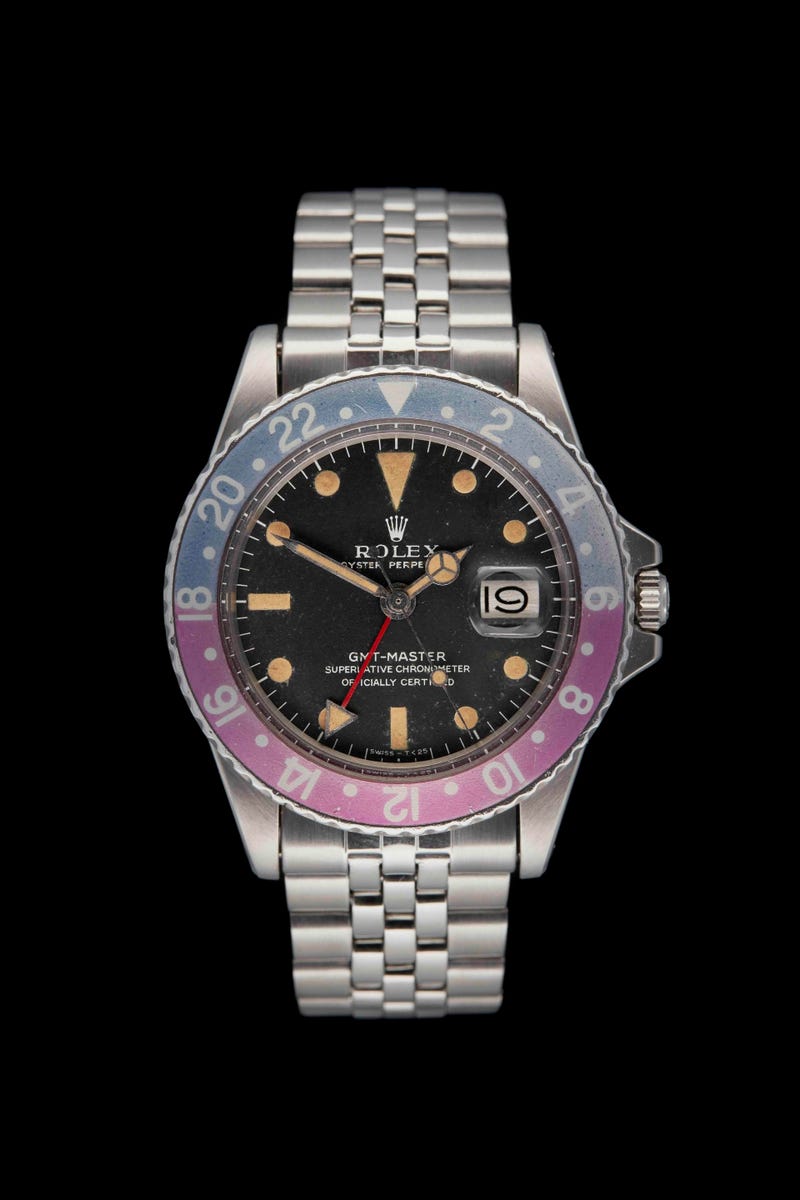
Yes, particularly where the two colours meet. On older watches, they fade and blend. You get extreme variations. You also get examples with a fuchsia tone, which is very desirable in the market.
People like that?
Very much so.
Where would you rank the GMT in Rolex’s all-time line-up?
It’s the most iconic sports watch. The Submariner dominated for a long time, but I’d say over the past ten years the GMT has overtaken it in terms of interest. The bezels fade in different ways, which people love. It appeals to both men and women. It’s a cross-continent watch. It also has that association with Greenwich Mean Time, so it’s quite UK-centric, which is nice. Some people still use the GMT function.
Come on.
[laughs] Maybe ten per cent of owners actually use it. And there are certainly more people travelling across time zones than there are diving [eg. who use a dive watch for its purported function].
I suppose that’s true.
Exactly. If you want to track London and Los Angeles time, it’s very easy. That’s part of the appeal.
When a discontinuation is on the cards, how does it affect your business?
You start stockpiling. It’s not the first time we’ve seen this. It’s not a shock. It’s more a case of understanding what it means. It means pieces become rarer and more desirable. There’s no modern equivalent coming through, so the spotlight shifts back to the older models.
So the Pepsi is gone for now, but Rolex still has GMTs.
The black and blue “Batman” (or “Batgirl”), the left-handed black and green “Sprite”, the green and black “Destro”, and the black and grey “Bruce Wayne.”
Yes.
But none of them quite has the same appeal.
No. And that’s why I always say, slightly tongue in cheek, if it had been called something else, would it be as popular? Probably not. Pepsi is an iconic label. It’s pairing one icon with another.
The Batman or the Hulk is somehow sillier?
They don’t have the same cultural weight. Coke and Pepsi are the two everyone remembers.
How important was that 2014 reintroduction in white gold?
Not very. Historically, it wasn’t made in white gold. The Pepsi identity is really rooted in the vintage [steel] pieces.
Rolex clearly has a strategy of taking things out of the catalogue and bringing them back.
Possibly, but I don’t know if that’s the case here.
Do you expect it to return?
Yes. I’d say within two to five years. There’s always demand, and people will want access to it again.
What general advice would you give someone looking to buy a vintage GMT?
The same as anything: condition, credibility of the seller, guarantees, mechanical warranties. Know your source.
Do you see many well-known names wearing them?
Ed Sheeran is known for wearing GMTs. But I’d say every serious Rolex collector has a Pepsi GMT in their collection. It’s one of those watches that, if you’re into watches, you have to have in your collection.
Do you have one yourself?
I’m wearing one now.
It's the Rolex most people picture when they think “Rolex”.
That’s the thing. More so than the Submariner now. The colour makes it instantly recognisable. That blue and red stands out.
On the other hand, is it a bit obvious? Would a serious collector go for something more under the radar, like an Explorer II?
No. I think it’s a very cool, stylish watch. It’s versatile. It looks great on a woman as well. I’m a big fan of the GMT. It’s always been in my collection. It’s on the inside cover of my book. It’s always been in my collection.
What are the big mistakes people make with vintage watches – over-polishing, for example?
Wear them and enjoy them. I’m not a big fan of over-protecting watches. These vintage pieces are robust enough for daily wear. And with GMTs, the more the bezel fades and changes, the more character and uniqueness they develop.
