Boeing's Real-Life X-Wing Starfighter Revealed
The X-Wing and Its Real-Life Counterpart
Science fiction is filled with iconic vehicles and starships, but few are as recognizable as the X-wing. While the TIE Fighter may also be a popular choice, most people tend to align themselves with the freedom fighters and their vehicles. Regardless of preference, the X-wing has become so closely associated with "Star Wars" that Boeing once built two real-life X-wing starfighters. The reason? Because of the power of the Force, or so it seems.
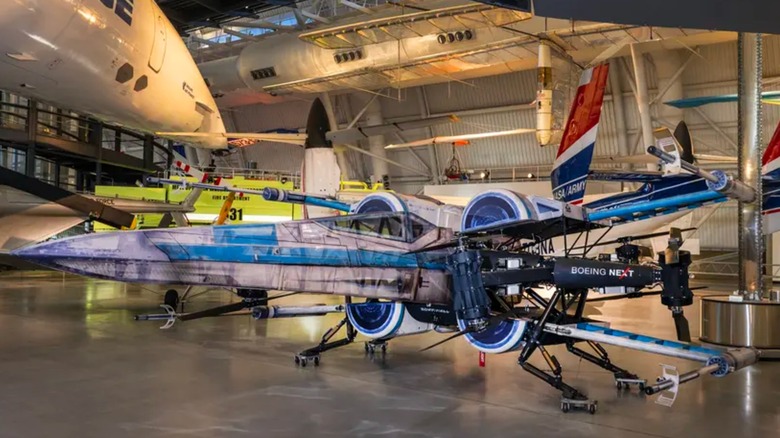
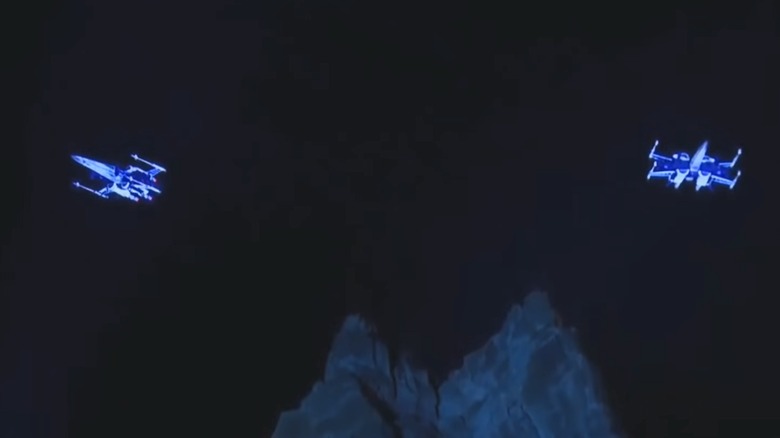
In 2019, Boeing collaborated with Walt Disney to celebrate the opening of Star Wars: Galaxy's Edge in Walt Disney World. As part of this partnership, Boeing modified two CV2 Cargo Air Vehicles (CAVs) to look like X-wings and flew them over the crowd. These CAVs could only hover slowly; they couldn't jump to lightspeed, and their wings were non-functional, remaining in the classic X-shaped attack position. To enhance the illusion, Disney's imagineers used ultraviolet spotlights to illuminate only the X-wing shells, masking the drones.
Although these drones weren't life-sized—each had a wingspan of just 20.2 feet—they were far enough away that most people couldn't tell the difference. One of the CV2 CAVs, complete with its X-wing shell, is now on display at the Smithsonian National Air and Space Museum's Steven F. Udvar-Hazy Center in Chantilly, Virginia. There, visitors can see the drone and its shell without the ultraviolet lights, offering a clearer view of how the machine functioned.
The CV2 CAV and Its Role in the X-Wing Project
The X-wing cosplay was the CV2's first and last major project.
Boeing started working on the CV2 CAV in 2017 with the intention of using it as remote-controlled delivery drones. The CV2 was designed to carry 500 pounds of cargo and also served as a testbed for Boeing's engineers. According to the Smithsonian National Air and Space Museum, the CV2 CAV became the "first remotely piloted large eVTOL (electrical vertical takeoff and landing) aircraft to be flown in support of a commercial operation in the United States." This operation, of course, involved impressing crowds by appearing as X-wings.
Unfortunately, Boeing faced significant challenges. In 2018 and 2019, two Boeing 737 Max airplanes were involved in fatal crashes, leading the company to ground its entire fleet to address the issues. In 2020, the COVID-19 pandemic brought the world to a standstill, resulting in a decline in airplane ticket sales. These events forced Boeing to shut down its NeXt division, which was responsible for projects like the CV2 CAV.
The irony of this situation is that the pandemic partially accelerated the development of autonomous delivery drones and similar technologies. Drones in China are now delivering everything from lunches to hospital supplies, and the U.S. Army is testing laser weapons to shoot down potentially dangerous drones. Boeing shutting down its drone development wing right before the surge in drone technology can best be described as a cosmic amount of bad luck. It could have been fleets of CV2 CAVs shipping military supplies and entertaining theme park attendees.
