China’s chipmakers rush to embrace DeepSeek’s V4. Which names stand out?
Rising Adoption of DeepSeek’s V4 AI Model by Chinese Firms
The release of DeepSeek's latest large language model, V4, has triggered a significant shift in the Chinese tech landscape. A growing number of domestic semiconductor manufacturers and artificial intelligence chipmakers are now integrating this model across diverse architectures. This move is driven by both technological advancements and geopolitical considerations surrounding advanced semiconductors.
Here are some of the key players that have successfully enabled the deployment of V4 on local hardware platforms:
Huawei
Huawei Technologies was among the first to act, fully adapting V4 to its Ascend 950PR chip platform. The company stated that its full line-up of AI processors—including the A2, A3, and 950 series—had completed compatibility, positioning the Ascend 950PR as a primary inference chip.
The optimized model delivers up to 2.87 times the single-card inference performance of Nvidia's China-specific H20 processor, while improving multimodal generation efficiency by 60 percent. Deployment costs are reported to be about one-tenth of comparable GPT-based services.
Huawei reportedly planned to produce about 750,000 Ascend 950PR chips in 2026, with mass production having started in April and shipments expected in the second half of the year, according to Reuters.
China's three largest internet groups—Alibaba Group Holding, ByteDance, and Tencent Holdings—have collectively placed orders for hundreds of thousands of Ascend 950 processors following the V4 launch, according to the Financial Times.
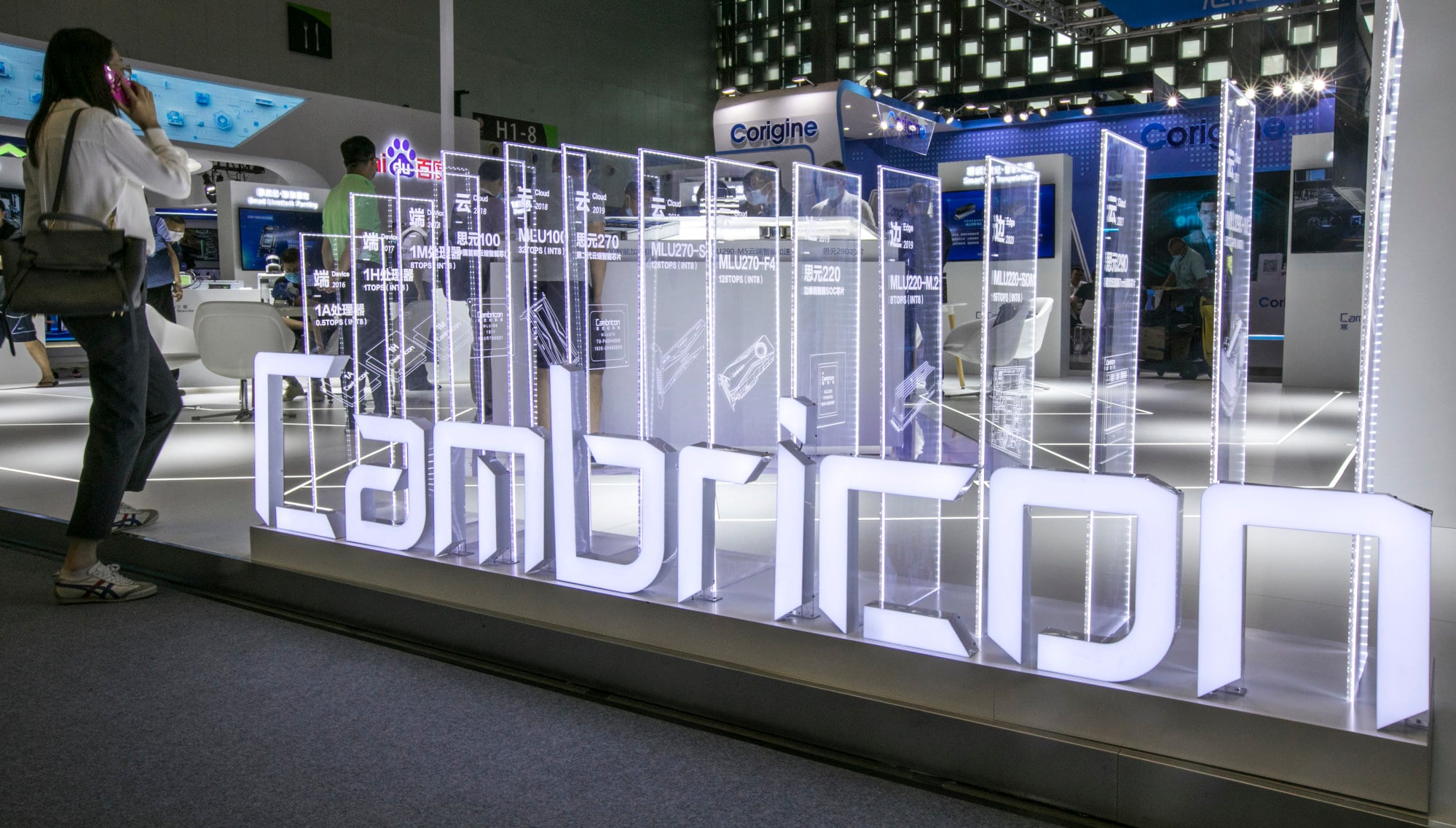
Cambricon
Cambricon Technologies said the V4 achieved full-stack adaptation on the day of release, with deployment code open-sourced simultaneously. It stated this achievement was the result of Cambricon's long-standing accumulation of its proprietary NeuWare software ecosystem and chip design technology, and represented a continuation of the company's investment in joint innovation in chips and algorithms.
MetaX (Muxi)
MetaX confirmed its Xiyun series chips achieved day-one compatibility with the V4 via the FlagOS platform, a cross-chip software system platform from the Beijing Academy of Artificial Intelligence. Shanghai-based MetaX, which focuses on graphics processing unit (GPU) design, software ecosystems, and computing cluster deployment, also works with the Shanghai Artificial Intelligence Laboratory to optimize core operators using its KernelSwift system.
Moore Threads
Moore Threads said its MTT S5000 GPU, a flagship chip built on its MUSA architecture, completed day-one adaptation of the V4. The chip supports native FP8 precision and enables inference deployment through the FlagOS platform, with support for extended context lengths and advanced inference modes.
T-Head (Alibaba)
T-Head, Alibaba's chip unit, was included in a FlagOS release confirming V4 compatibility across eight domestic chip architectures. The FlagOS announcement from the Beijing Academy of Artificial Intelligence represents a widely referenced ecosystem-level compatibility initiative covering multiple chip vendors.
Formed from the integration of C-SKY Microsystems and the DAMO Academy's chip team, T-Head had shipped 470,000 GPU chips as of February 2026, with annualized revenue of about 10 billion yuan (US$1.5 billion). Alibaba owns the South China Morning Post.
Kunlunxin
Kunlunxin, backed by Baidu, was also included in the FlagOS release. Its mass-produced AI chips are widely deployed in Baidu's search infrastructure.
Hygon
Hygon Information Technology, the only domestic firm with a permanent x86 license from leading US semiconductor company AMD—giving it a rare hybrid position in China's central processing units (CPUs) ecosystem—also confirmed compatibility through FlagOS. It produces high-end CPUs and deep computing units (DCUs), including the Shensuan No 2 (DCU 8000 series) and Shensuan No 3 (BW1000) processors.
Iluvatar CoreX
The Shanghai-based company, which focuses on general-purpose GPUs, announced day-one compatibility with the full V4 suite, though specific chip models were not disclosed.
Enflame
Enflame Technology said its fourth-generation L600 chip, released in 2025, had been adapted to support the V4 Pro and Flash models at native FP8 precision. The company did not disclose further details on hardware-level optimization.
The company's architecture is positioned closer to a purpose-built AI accelerator design, similar to Google's TPU, reflecting a strategy focused on efficiency over general-purpose GPU computing.
