2D Magnetic Phases Finally Observed in Atom-Thin Material
Breakthrough in Understanding Magnetism in Ultra-Thin Materials
Physicists at The University of Texas at Austin have made a significant discovery by experimentally confirming a long-standing theory about how magnetism behaves in ultra-thin materials. This breakthrough centers on the behavior of an atomically thin crystal known as nickel phosphorus trisulfide, or NiPS3. By cooling this material to extremely low temperatures, the research team observed a full sequence of magnetic phases that were predicted in the 1970s but never fully demonstrated in a single system.
The study focused on two distinct magnetic transitions that occur as the material is cooled. While each transition had been seen individually in previous experiments, the researchers managed to capture both in succession, completing the theoretical picture. This achievement represents a major step forward in understanding the complex behavior of magnetic systems at the nanoscale.
The Berezinskii–Kosterlitz–Thouless Phase
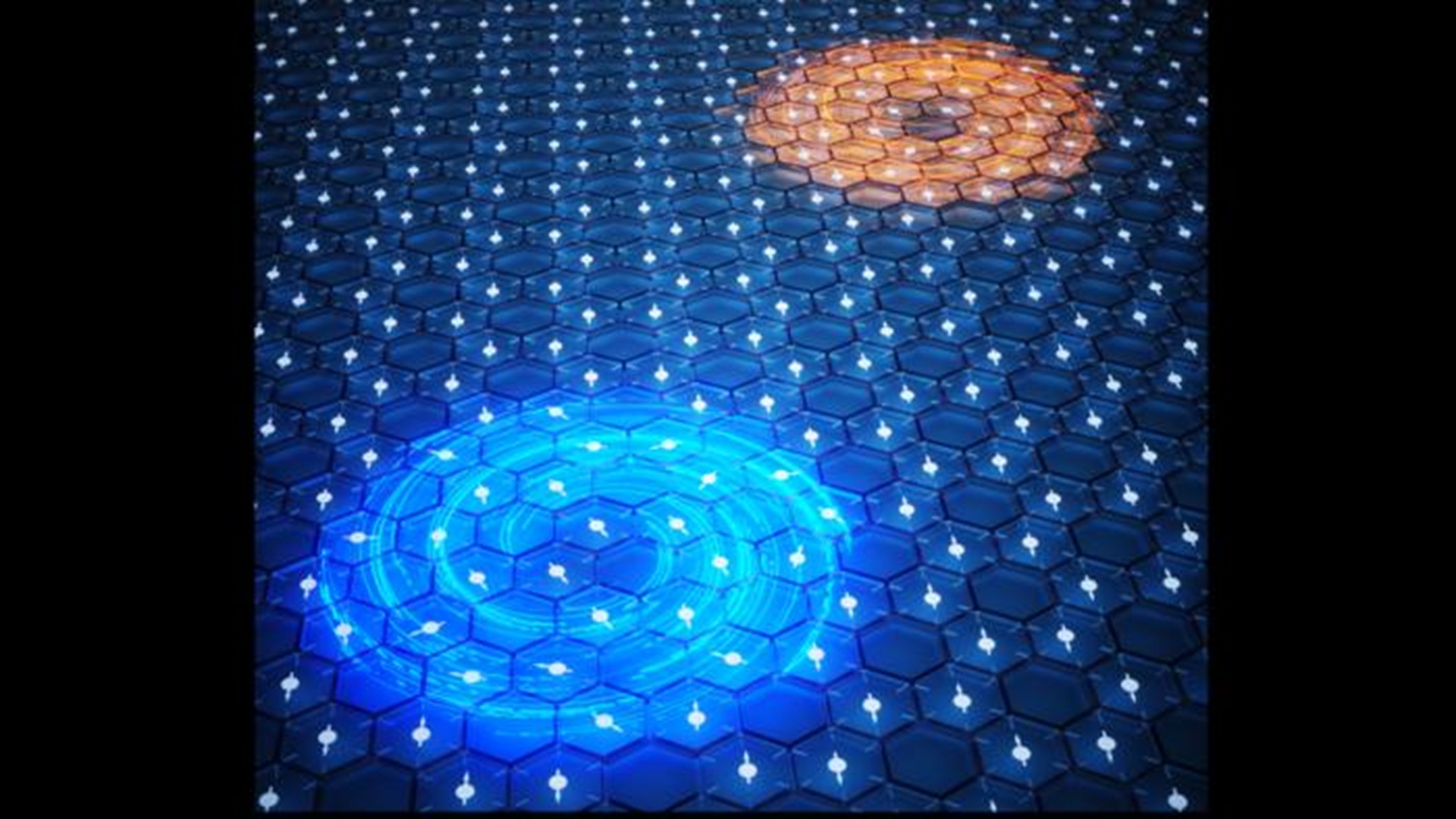
As the temperature dropped to between –150 and –130 degrees Celsius, the material entered a rare state known as the Berezinskii–Kosterlitz–Thouless (BKT) phase. In this state, atomic magnetic moments arrange themselves into swirling vortex patterns. These vortices form in pairs, rotating in opposite directions—one clockwise and the other counterclockwise. The paired structures remain tightly bound together, creating a unique topological state confined within a single atomic layer.
“This phase is particularly intriguing because these vortices are predicted to be exceptionally robust and confined to just a few nanometers laterally while occupying only a single atomic layer in thickness,” said Edoardo Baldini, assistant professor of physics at UT and leader of the research. “Because of their stability and extremely small size, these vortices offer a new route to controlling magnetism at the nanoscale and provide insight into universal topological physics in two-dimensional systems.”
The BKT phase was named after theorists Vadim Berezinskii and Nobel Prize winners J. Michael Kosterlitz and David Thouless, who described this type of phase transition decades ago. Their work earned the 2016 Nobel Prize in Physics.
The Six-State Clock Ordered Phase
As the team continued to cool the material further, it entered a second magnetic regime known as the six-state clock ordered phase. In this state, the magnetic moments no longer swirl freely but instead lock into one of six symmetry-related directions. This phase completes the sequence of magnetic transitions predicted by the six-state clock model, a cornerstone framework in theoretical condensed matter physics.
“The findings suggest that other two-dimensional magnetic materials may host similar hidden phases,” said Baldini. “Researchers believe the ability to manipulate such nanoscale vortices could eventually support ultracompact devices, potentially shrinking magnetic memory or logic components to unprecedented scales.”
Implications for Future Research
The study, published in Nature Materials, marks a significant milestone in the field of condensed matter physics. It not only confirms a decades-old theory but also opens up new possibilities for exploring and manipulating magnetic properties at the nanoscale.
Future work will focus on stabilizing these exotic phases at higher temperatures, possibly even approaching room temperature. If achieved, this would move the physics from cryogenic laboratories toward practical technologies, paving the way for innovative applications in data storage, computing, and other fields.
Key Takeaways
- The research team at The University of Texas at Austin confirmed a 1970s theory about magnetism in ultra-thin materials.
- They observed two distinct magnetic transitions in a single system: the Berezinskii–Kosterlitz–Thouless (BKT) phase and the six-state clock ordered phase.
- The BKT phase involves swirling vortex patterns that are stable and confined to a single atomic layer.
- The six-state clock ordered phase sees magnetic moments locking into specific directions, completing the theoretical sequence.
- The findings suggest that other two-dimensional magnetic materials may exhibit similar properties.
- Future research aims to stabilize these phases at higher temperatures, potentially leading to practical applications in technology.
