Color cue shows bumblebees make smart choices
The Decision-Making Process of Bumblebees
During their search for food, most insects head specifically for the flowers that promise the highest reward. But how do they know which ones to choose? Researchers from the University of Konstanz and the University of Würzburg have now studied how bumblebees process information about their food sources.
When we face choices, such as selecting the sweetest strawberries on a supermarket shelf, we rely on various sensory inputs and past experiences. Similarly, animals, including bumblebees, make decisions based on the information available to them. A recent study by the University of Konstanz in cooperation with the University of Würzburg investigated the decision-making behavior of bumblebees and found that these insects take a "shortcut" in information processing if it saves them time. In this respect, their decision-making behavior is indeed quite similar to that of humans.
Understanding Bumblebee Behavior
Bumblebees are known to visit hundreds of flowers each day while foraging for their colony. Each time, they must decide which flowers are likely to offer the greatest reward. Anna Stöckl, a neuroethologist at the University of Konstanz and co-author of the study, explains that bumblebees are particularly well-suited for studying decision-making processes due to the high number of decisions they make in short periods.
To avoid wasting energy on flights with little prospect of success, bumblebees memorize which types of flowers previously contained nectar or pollen. This helps them identify potential food sources quickly. Stöckl notes that bumblebees primarily rely on flower colors but are also capable of recognizing shapes, patterns, and scents—similar to how people might assess strawberries based on color and smell.
Testing Bumblebee Learning
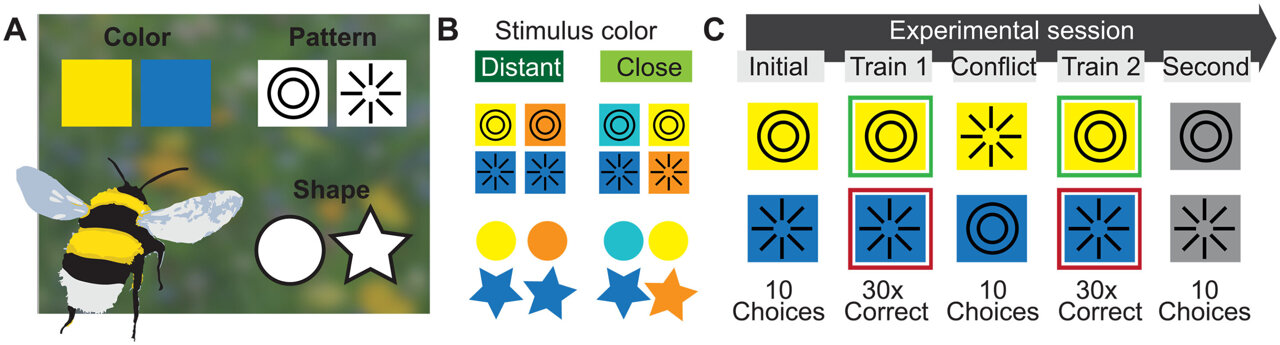
To determine how many features bumblebees store to identify good food sources, researchers trained the insects to associate specific combinations of traits with rewards. Artificial flowers with different color combinations were paired with either a pattern or a shape. For example, a blue, star-shaped flower might be rewarded with a sugar solution, while a yellow, round flower contained only water.
After several rounds, the researchers observed that the bumblebees increasingly chose the flowers with the sugar solution. This indicated that the insects had memorized the flowers' features and used this information in their decision-making.
Focusing on Essentials
The next step was to determine whether bumblebees relied more on shape, color, or both. Researchers mixed the trained colors and shapes, forcing the bumblebees to choose between learned features. For instance, a star-shaped flower might be yellow, while a round flower could be blue.
The results showed that the bumblebees continued to choose the color they had learned, expecting to find nectar at the blue flower. In a final test, all flowers were uniformly gray, with only the shape or pattern indicating the reward. The outcome was clear: Only when the colors in the training phase were difficult to distinguish did the bumblebees also remember the shape, choosing the correct one more frequently when the flowers were gray.
Adapting to Complexity
What intrigued the researchers was the amount of time bumblebees needed during the training phase. Those trained with clearly distinguishable colors learned faster than those trained with similar colors. Johannes Spaethe, a biologist from the University of Würzburg and co-author of the study, noted that learning and storing only the color required less processing effort than remembering both color and shape.
Stöckl explained that this strategy allows bumblebees to conserve resources. By following the principle of "as much as necessary, as little as possible," they achieve the best possible outcome.
Similarities to Human Decision-Making
The bumblebees' decision-making is remarkably similar to that of humans. When faced with unripe green strawberries, most people will naturally choose the red ones. However, if all the strawberries on display are deep red, it becomes helpful to know what ripe strawberries smell like.
This research provides valuable insights into how animals, including bumblebees, process and store information to make efficient decisions. It highlights the importance of adaptability and resource conservation in decision-making processes, both in nature and in human behavior.
