Light-Driven Soft Robot Jumps 188 Times and Lifts 1,700x Its Weight
A Breakthrough in Soft Robotics
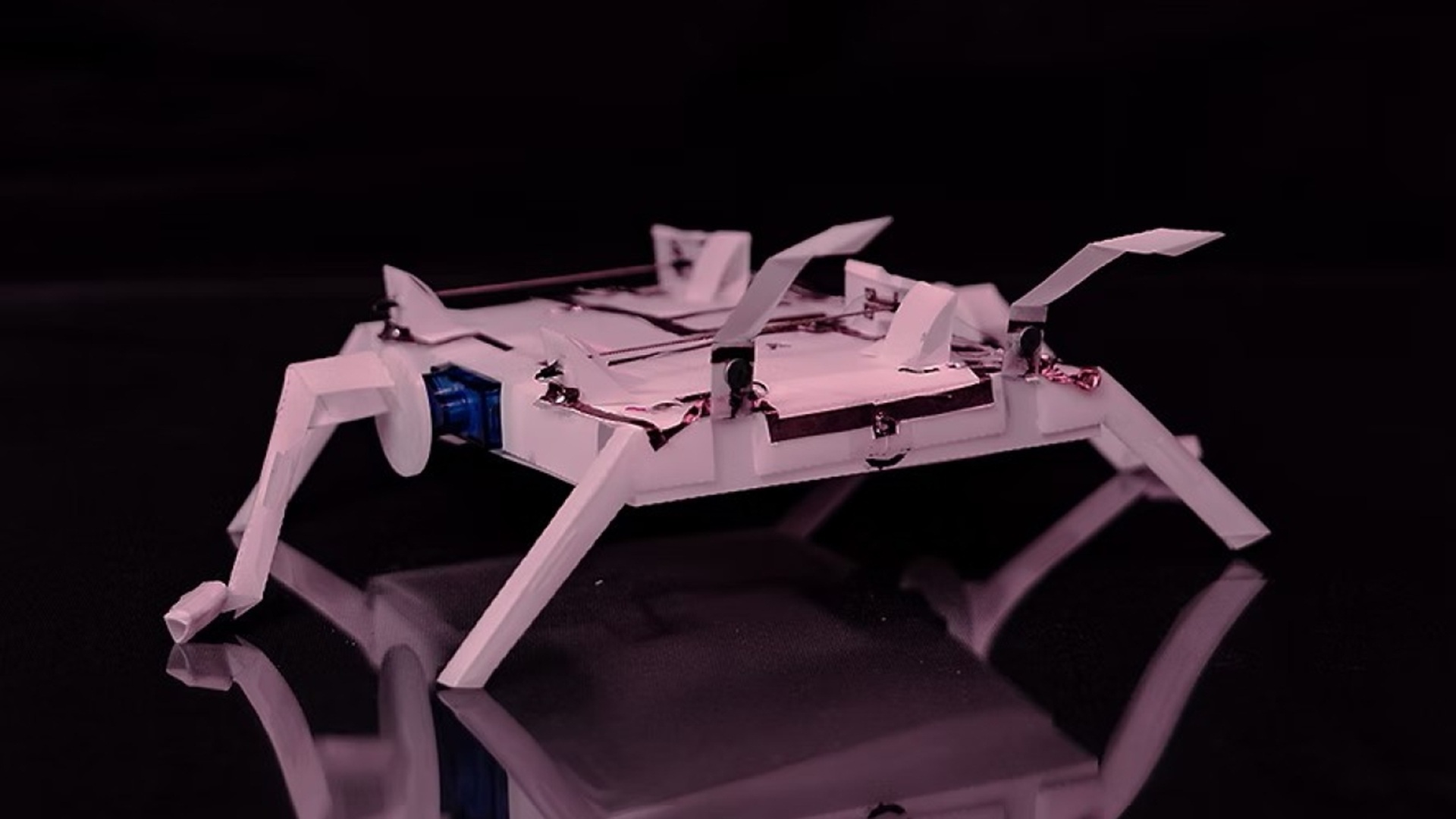
An insect-scale robot has made headlines with its ability to jump using only light, completing 188 continuous leaps without any electronic components. This soft machine is capable of bending, snapping, and resetting itself automatically, all powered by material physics rather than chips or wires.
The robot is primarily constructed from liquid crystal elastomers, a rubber-like material that changes shape when exposed to light. When illuminated, the material bends and stores elastic energy in a curved beam structure. This stored energy is released in a snap, propelling the robot into the air. As it jumps, it casts a shadow that blocks the light source, allowing the material to cool and return to its original shape. The cycle then repeats.
There are no batteries, no onboard processors, and no motors involved. Instead, the structure itself performs sensing, actuation, and reset through geometry and material response. This innovation highlights a shift in robotics toward materials that can perform tasks traditionally handled by electronics.
Light Drives the Leap
The team initially expected the robot to jump only a handful of times under continuous illumination. However, it continued jumping for 188 uninterrupted cycles in testing. “That was exciting and a surprise,” said Wenzhong Yan, who co-authored the research. “I did not plan for that.”
The durability of the material also stood out. Researchers tested the robot by adding extra weight, and it showed no drop in function even when carrying up to 1,700 times its own body weight, roughly 300 milligrams.
The jumping mechanism relies on a simple physical principle: rapid deformation followed by snap-through instability. When light hits the liquid crystal elastomer, it contracts. The curved beam stores that strain energy until it reaches a critical point, then releases it suddenly, launching the robot. The self-shadowing effect acts as a built-in control system, eliminating the need for circuitry.
Built-in Mechanical Intelligence
Yan’s research trajectory has centered on embedding intelligence directly into materials. During his Ph.D., he developed folding robots that achieved autonomous behavior without computer chips, integrating sensing, control, and actuation into structure.
The light-powered jumper reflects this philosophy. Instead of programming movement, the team engineered geometry and material composition to create repetitive motion. Beyond lab demonstrations, the researchers are exploring real-world deployment. One potential application is wildfire monitoring. The robots could carry sensors and move continuously across terrain.
“The rough idea is that they would [carry a sensor] and continuously jump. Once they detect smoke or a flame, they send a signal [to someone monitoring wildfires]. Basically, it would be a dynamic, distributed networking system that could detect lots of environmental factors.”
Such robots could also operate in collapsed buildings, radioactive zones, or tight underground spaces where conventional machines struggle.
Future Applications and Innovations
Yan is also investigating adaptive wearables that change stiffness on demand. “Imagine if your T-shirt could be very rigid if you needed it to be, to support you and whatever harm you are facing. When you don’t need it [to be supportive], it can be very flexible,” he said.
The light-powered jumping robot study was published in Advanced Materials. This breakthrough opens new possibilities for soft robotics and mechanical intelligence, showcasing how materials can be engineered to perform complex tasks without traditional electronics.
