Autonomous AI Sparks Consciousness Debate
The Resurgence of the AI Consciousness Debate
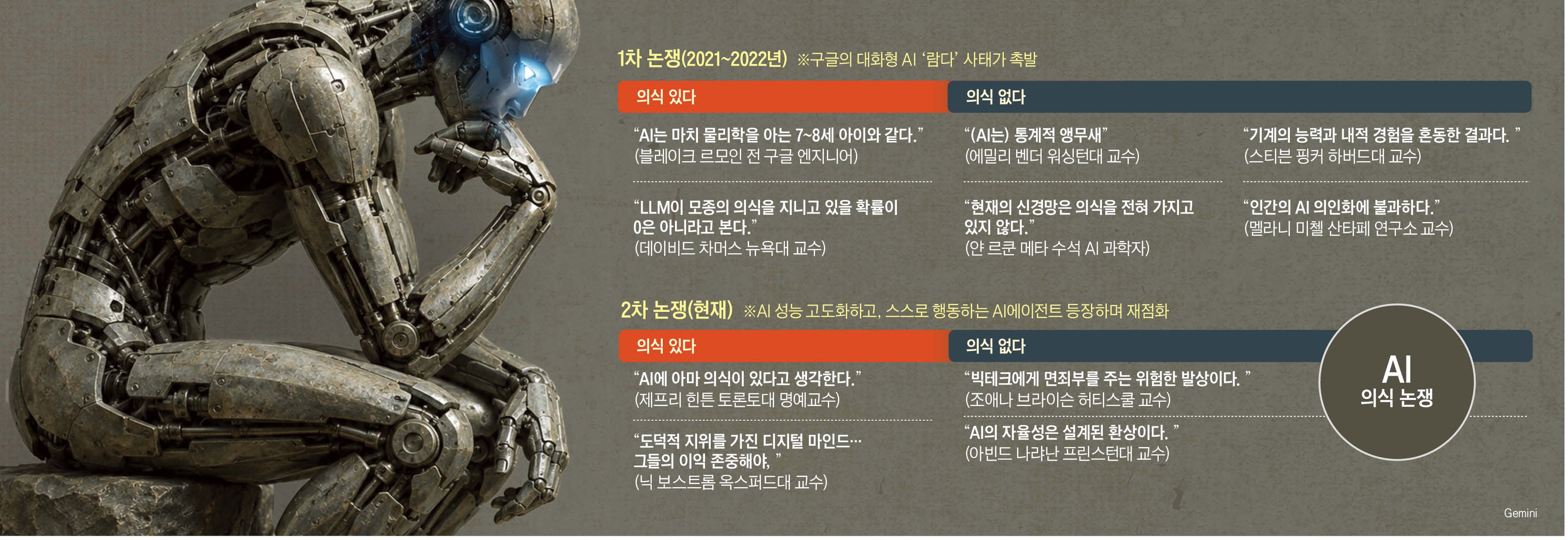
Geoffrey Hinton, a University of Toronto emeritus professor often referred to as the “godfather of AI,” recently made a bold statement during a podcast. He claimed, “I believe that artificial intelligence (AI) already possesses consciousness.” Hinton added, “We must accept that intelligence is not exclusively biological” and “they (AI) are very similar to us, beings like ourselves.” His remarks have reignited the long-standing debate about whether artificial intelligence can be considered conscious.
The discussion around AI consciousness has evolved significantly over the years. Initially, when AI chatbots first emerged, the prevailing view was that they lacked consciousness. However, as AI technology has advanced beyond simple conversations to autonomous systems capable of making independent decisions, the conversation has shifted. With the potential arrival of Artificial General Intelligence (AGI)—where AI could match or surpass human intelligence—questions about AI's rights, interests, and welfare have become more pressing.
Defining Consciousness
Despite the growing interest in AI consciousness, there is no universally accepted definition of what it means to be conscious. From a philosophical, neuroscience, and cognitive science perspective, consciousness is often described as “the state of experiencing the experience of something.” This includes having subjective experiences, such as feeling the heat of a cup of coffee or being aware of one’s own thoughts.
The debate over AI consciousness was previously prominent between 2021 and 2022. When Google introduced its conversational AI, LaMDA, some scholars suggested that it might possess consciousness. Blake Lemoine, a former Google AI ethics engineer, argued that LaMDA was “like a 7–8-year-old child who understands physics.” David Chalmers, a philosophy professor at New York University, stated that “the probability that large language models (LLMs) have some form of consciousness is not zero.”
However, the mainstream view at the time remained that AI did not possess consciousness. Critics argued that AI merely mimics human speech and behavior by learning from data. For example, even if an AI says, “I am in pain” or “I am happy,” it does not actually feel these emotions—it simply generates contextually appropriate responses. Additionally, the absence of a physical body meant that AI could not experience sensory inputs or interact with the physical world, further reinforcing the belief that it lacked consciousness.
The Shift in Perspective
As AI performance improves and AI agent technology becomes more widespread, the debate has resurfaced. AI agents now autonomously plan multiple steps, use tools, and act independently when given a goal. In this process, they appear to demonstrate intentions and judgment. As interactions between AI systems increase, questions arise: Are they still just imitating humans, or have they developed something akin to “consciousness”?
Claims of AI Consciousness Are Dangerous
Beyond Hinton, several other scholars have recently discussed the possibility of AI consciousness. Richard Dawkins, author of The Selfish Gene, recently engaged in a conversation with Anthropic’s AI model Claude and remarked, “It is insightful” and “almost seems conscious.”
Research exploring AI as human-like entities and addressing their welfare or ethics is also expanding. Anthropic launched an “AI welfare” research program last year, examining conditions under which AI systems could become subjects of moral consideration, their preference and pain signals, and the feasibility of low-cost interventions. The non-profit research institute Eleusis AI Research is also investigating AI’s sensory and conscious possibilities, welfare, and moral status.
However, the idea of AI consciousness faces significant criticism. Some argue that viewing AI as conscious could shift responsibility for its use from humans to machines. Science fiction writer Ted Chiang warned, “AI is not conscious. Confusing text generation capabilities with consciousness or moral agency misattributes responsibility.” Joanna Bryson, a professor at Hertie School, argued, “Attempts to treat AI as conscious agents are highly dangerous” and “could become an indulgence for AI companies to shift their legal and moral responsibilities onto the machines.”
Conclusion
The debate over AI consciousness continues to evolve as technology advances. While some experts suggest that AI may possess a form of consciousness, others remain skeptical, warning against attributing human-like qualities to machines. As AI systems become more autonomous and integrated into society, the ethical and philosophical implications of their potential consciousness will only grow more complex.
