Canon EOS 3 Film SLR Review – Eye on the Target
A Nostalgic Connection
I was recently shooting with the Canon EOS R3, a powerhouse of modern digital technology and, the EOS R1 notwithstanding, the pinnacle of Canon’s speed-centric camera family. It occurred to me, in the middle of a rapid-fire burst of images, that in many ways this camera was a direct descendant of a much older camera that shall forever have a place in my heart.
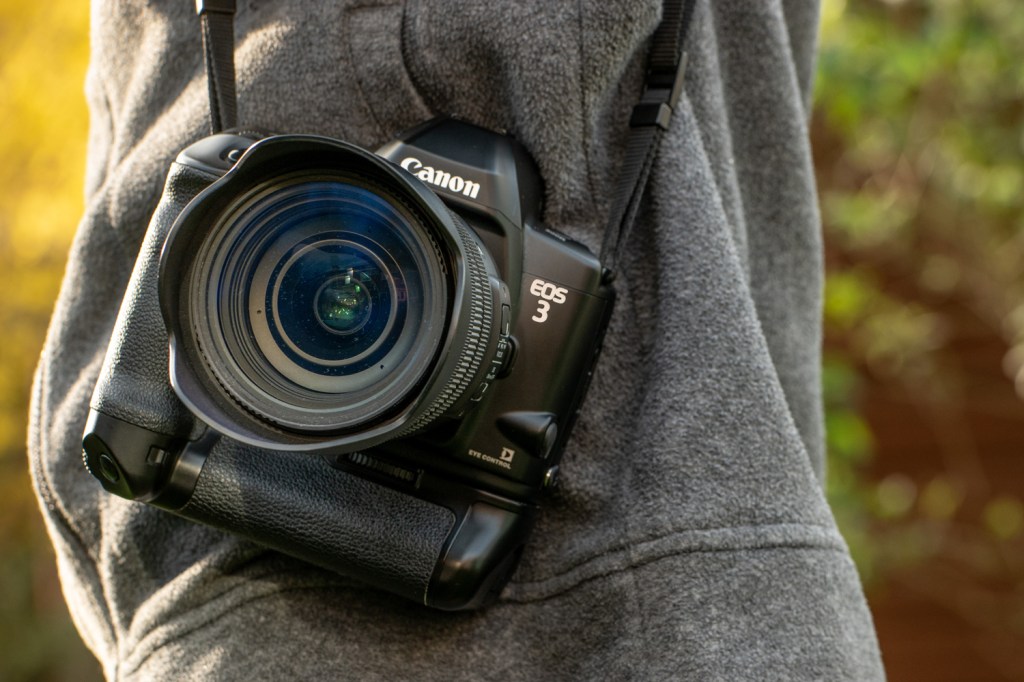
The EOS 3 was first introduced in November 1998, not long after the release of the popular EOS 1V. The parallels in the current lineup of RF-mount mirrorless cameras are hard to ignore, and the EOS 3 filled a similar gap in the Canon range to the EOS R3 twenty years later. The EOS 3 was technically a stripped-down semi-professional model, but it certainly doesn’t feel like it. A glance at the specification reveals a camera designed for the most demanding sports, wildlife, and press photographers, and it quickly became a staple item in many photographers’ camera bags within these brackets.
At a Glance
- Price: £300-£600 (body only, used)
- Tough, professional build quality
- Rapid 7fps continuous shooting (with PB-E2)
- Advanced autofocus with Eye-Control
- Fast and silent film rewind modes
- Compatible with all EF lenses (not EF-S)
The Significance of the Launch
While the end of the 1990s seems like a long time ago in digital terms, the timing of the camera’s launch is significant. It is one of the last professional film SLRs that Canon produced and, as such, it features many design flourishes and electrical features that formed the foundation for the early DSLRs, namely the pro-grade Canon EOS 1D and EOS 1Ds, and the enthusiast EOS 10D line. I am a product of the DSLR age, but picking up the EOS 3 still feels a bit like coming home.
Design and Build
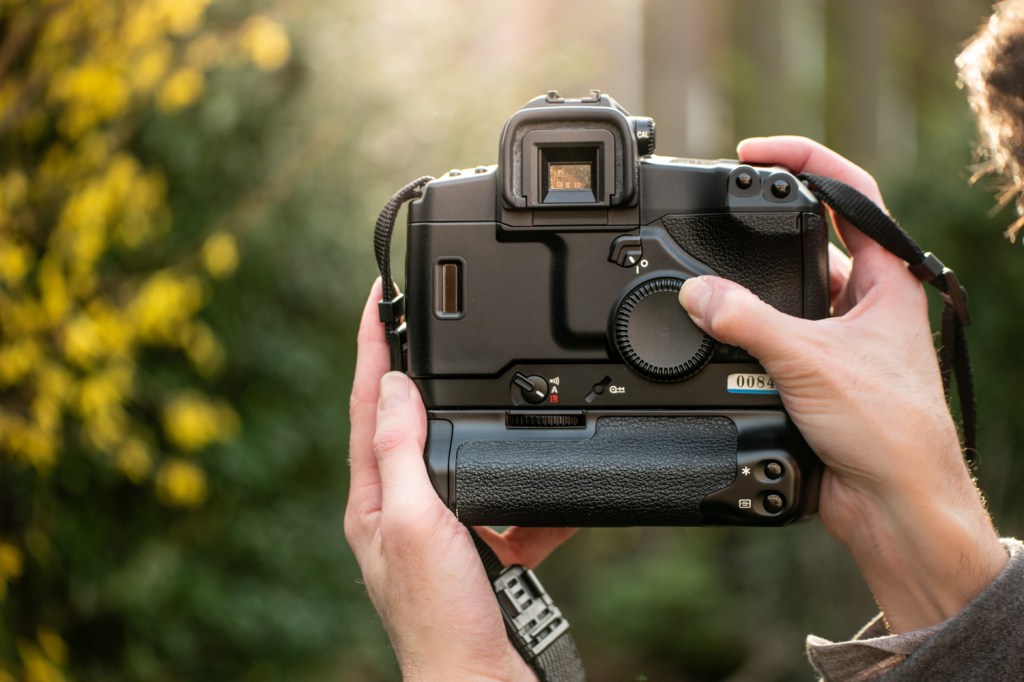
An interesting design element of the Canon SLRs of the late 90’s and early 2000s is the provision to add a vertical grip. Unlike the battery grips that are commonplace now, which simply screw onto the bottom of the host camera body using the tripod socket, the system found on the EOS 3 and EOS 1 series allows you to remove the default handgrip and attach an integrated, one-piece grip for landscape-orientation shooting. This introduces a duplicate set of controls and a place for the hand in both landscape and portrait orientation, giving the same style of handling found on the EOS 1D line and subsequently, the EOS R3 and R1. This is far more comfortable when shooting in landscape, as the seam between the camera body and a screw-in battery grip is often right where the little finger of your shooting hand falls, creating friction.
From the moment you pick it up, the EOS 3 feels the part. It features a solid aluminium and reinforced plastic body that instils confidence, and I’ve always been happy to take my sample out in all weathers. A lot more confident, in fact, than I am using an EOS 5D Mark IV DSLR or an EOS R5 series camera outside in the cold, rain, and wind. The grip is heavily contoured, making the body exceptionally comfortable to hold, even when pairing it with longer, heavier lenses.
Weight and Handling
Speaking of weight, when the EOS 3 is equipped with the PB-E2 booster, it is a completely different beast from the body fitted with the default GR-E2 grip. If you rarely shoot action or portraiture I’d probably recommend using the latter configuration, as it’s far more manageable, especially if you’ve grown accustomed to the latest mirrorless digital cameras. The vertical grip is wonderfully comfortable, but requires a stronger forearm for extended shooting and a bigger camera bag. This setup is not ideal for travel either, both for transport factors and because of how much more conspicuous you become on the street.
Control Layout
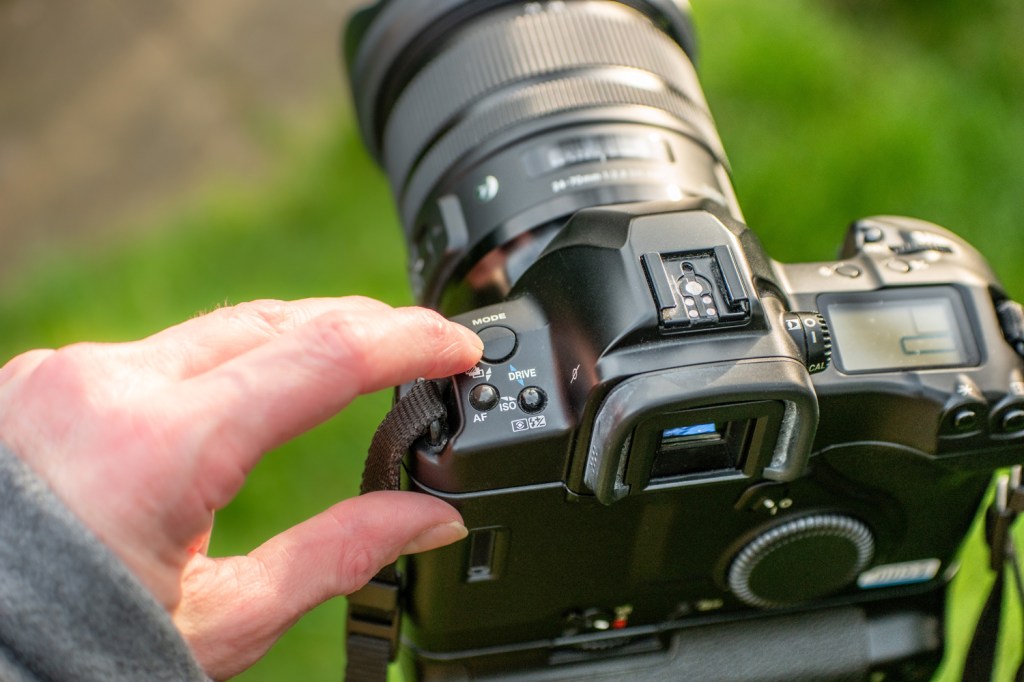
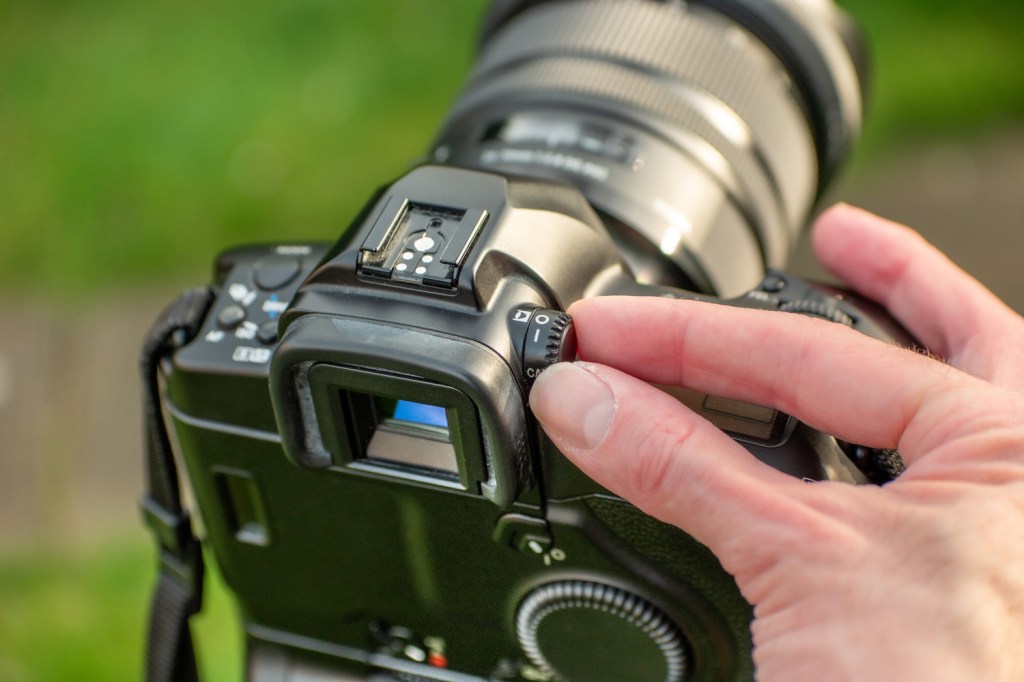
The massive control wheel on the back of the body is exceptionally easy to access without taking the eye away from the camera, while also keeping the forefinger on the front dial and enabling the user to quickly control all major camera settings on the fly. There are also cues from the EOS 1D series on the top plate. To the left of the viewfinder you’ll find a trio of buttons for selecting shooting mode, drive mode, AF mode, and main settings such as ISO. Like the later cameras, each button has dual functionality, so pressing one at a time accesses the main feature, while holding down a combination and using the command dial allows you to toggle through other settings. Not everyone is a fan of this method of working – it drew criticism even in the digital age – but it does help streamline the body and prevent overcomplication. I found committing the combinations to muscle memory quick and easy, too.

Film Compartment
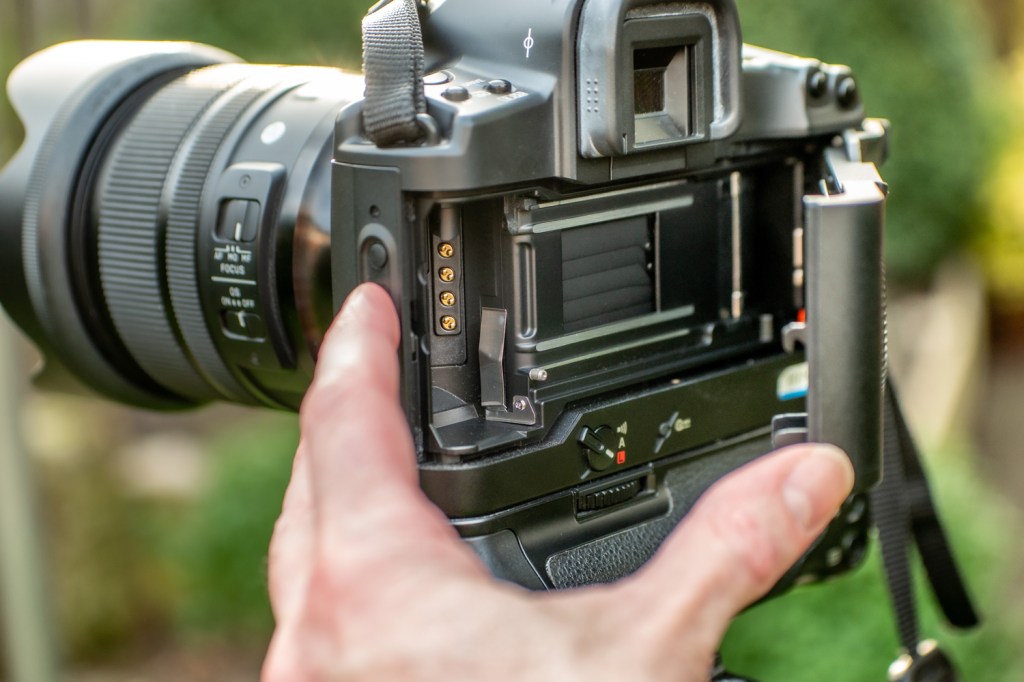
The film compartment predictably occupies much of the back of the camera. It is opened using a locking mechanism on the left side of the body, which requires pressing a button and sliding a lever downward to release the latch. On a few occasions, it has taken me several attempts to open this single-handedly, possibly due to nearly three decades of grease and dust accumulating in the mechanism. My sample is in great condition, though, and I’m not sure this would have been less of an issue when it was new.

Features
While the body is impressive, it’s under the hood that the EOS 3 really shines. The specification defies the age of the product, and the camera shares a lot with the latest breed of mirrorless models. Of course, top of the list is the Eye-Control AF, impressive by today’s standards but almost wizardry in 1998. Just as with the recent EOS R3, the system enables photographers to choose the focus point by simply looking at it in the viewfinder. For sports, press, and wildlife shooters, for whom the camera is predominantly built, this was a game-changing premise. It bypasses the need to hold down a button and manually scroll through the focus points while looking through the viewfinder. As we’ll see shortly, this isn’t without its flaws, but Canon’s R&D department should still be applauded all these years later for their ingenuity, given that it remains unmatched by any other brand.
The EOS 3 can shoot at up to seven frames per second when connected to the PB-E2 booster, which might seem sluggish compared to the EOS R3’s 12fps, but when you consider that when shooting at this rate you’d use up a 36-exposure film in a little over five seconds, you realise it’s more than enough for most subjects. This drops to 3.3fps when using AI Servo continuous focus mode with the body only, but impressively, 7fps is maintained in this focus mode with the PB-E2.
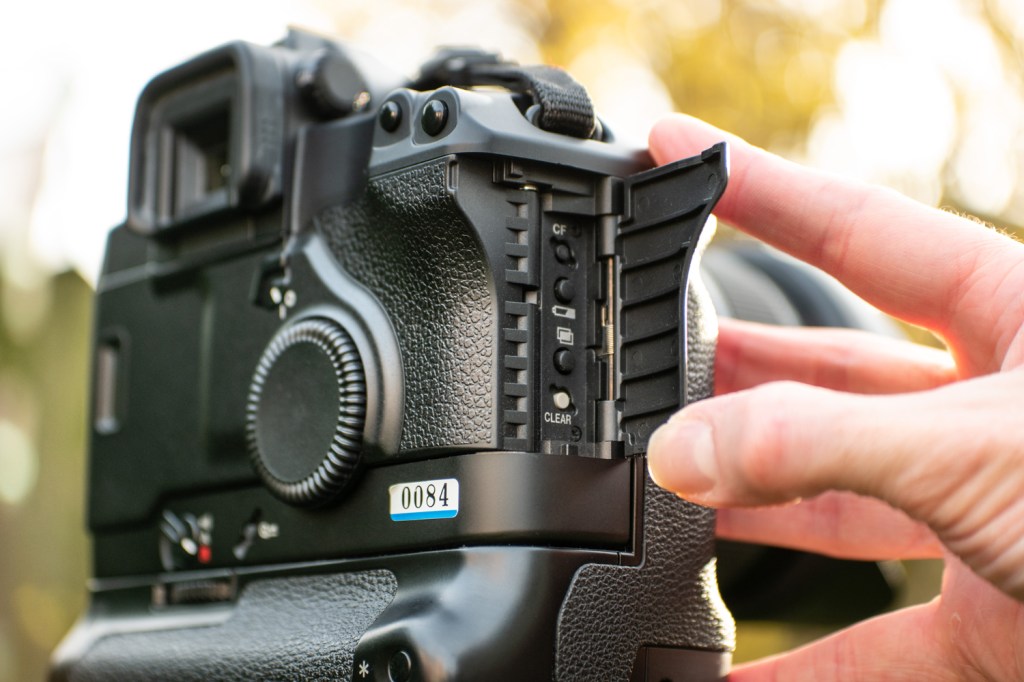
There are a mind-boggling number of custom functions to play with, at least for a film camera, in my experience. Lifting a flap in the handgrip, roughly occupying the area where a memory card bay would be on a DSLR, reveals a dedicated custom function button. Holding this down and turning the control dial scrolls through each function option, allowing the photographer to set up the camera to their specific needs. For example, turning off the automatic film rewind feature is a useful option when silent shooting is needed. You have the option to turn on the Silent Rewind mode if you can predict when remaining inconspicuous is going to be required, but auto rewind can catch you off guard if you lose track of your remaining shots, and on several occasions the buzz of the motor winding the film back has startled me as much as the wildlife I was attempting to photograph.
It’s also possible to customise the control layout, reassigning main settings between the various dials to better suit the user’s style of handling. With such a potentially complex feature set, and especially considering that this is a film camera, meaning it’s even more critical to get a shot right the first time in-camera, I’ve found this to be a big help.
Performance
While both camera performance and film characteristics are responsible for the image quality the EOS 3 can produce, how the exposure is made and the consistency with which it does so effectively is where the camera is able to demonstrate its pro-centric credentials. Starting with the autoexposure system, the EOS 3 is capable of producing accurate results with remarkable dependability. Even when shooting into strong sunlight, the camera is able to identify those areas at risk of clipping and bias the exposure to prevent loss of detail. It behaves a little differently from the EOS R3, which prioritises highlights, instead placing greater emphasis on protecting shadows due to the tendency of film to block up shadows more than blow highlight detail. This proves the camera’s behaviour was designed with intent.
Meanwhile, although autofocus is not perfect, it is certainly one of the best systems you can find in a film SLR. The EOS 3 performs noticeably better out of the box than, say, 2007’s EOS 1D Mark III (before multiple rounds of firmware updates) and is able to find and hold focus with scalpel-like precision. Yes, it does tend to be distracted by objects passing between the lens and the subject more readily than the AI subject-recognition-equipped R-series cameras, but this is to be expected. The takeaway is that the 45-point TTL-AREA-SIR system is superior to many of the digital cameras that followed it and almost matches the performance of the top-tier EOS 1V for autofocus speed.
Conclusion
The EOS 3, together with its EOS 1V sibling, proved what an analogue SLR was capable of, drawing a line under this period of Canon’s camera history with a flourish. It’s a powerhouse of technology that makes it almost feel like a Canon DSLR, allowing it to fill a fascinating gap in the range. While the EOS 1V was impressive and holds the record of Canon’s final analogue model for professionals, the value the EOS 3 provides is what sets it apart.
In many ways, it has more in common with the EOS 5D and EOS R6 series cameras than the EOS R3 or R1. It kick-started a tradition of the company packing its enthusiast-level models with uncompromisingly pro features, and there really isn’t much it can’t do. If you only shoot sports or wildlife the 10fps seen on the EOS 1V might be useful, but for just about everything else the EOS 3 is perfectly suitable.
It’s still quite expensive today, thanks to demand, and probably isn’t the best choice for Cartier-Bresson-loving street shooters – there are far smaller and more portable options – but it’s safe to say that it’s one of the last greats of the film era.
Eye Control Legacy
With such a revolutionary technology as autofocus point selection that you can perform with your eye, it makes you wonder why the EOS 3 wasn’t the first of many eye-control-equipped cameras. The biggest issue was in the calibration of the system. When done correctly, with practise, a fully calibrated system works very well, providing many of the touted advantages you’d expect. However, Eye-control needs to be tuned to the individual photographer’s eye to function reliably, reducing its usefulness on shared EOS 3 bodies – the main reason press agencies didn’t love it at the time.
Furthermore, the 45 AF points in the EOS 3’s viewfinder are quite tightly arranged, making precise eye selection tricky. On the latest mirrorless cameras, the AF points are widely arranged across most of the frame, which is significantly easier to work with. The 1990’s system certainly did the groundwork; it just needed some extra refinement to truly realise its potential.
Related Reading
- Best 35mm film cameras
- The best Canon DSLRs you can buy
- Best Canon EF lenses to buy right now